
Showing posts with label education. Show all posts
Showing posts with label education. Show all posts
March 30, 2015
Right to Work is wrong.
"Right to Work"
It's like the Patriot Act. You can't be against the Patriot Act.
Just like you can't be against something called Right to Work. Who doesn't want the Right to Work.
I, for one, don't want the Right to Work.
I want the Right to Organize.
I want the Right to Collectively Bargain.
I want the Right to Earn a Fair Wage.
I want the Right to Bargain my Working Conditions.
I don't want the Right to Work-for-Less.
Right to Work is wrong.

February 10, 2015
Testing...testing...more testing
A few weeks ago I met for our annual winter retreat with the Ohio Education Association (OEA) Board of Directors.
As one of our activities, we answered a few questions which we then discussed with another member of the Board. The question set I chose to answer started by asking if I was proud of my job and went on from there.
I am proud of my job. I do a job that matters. Every day I interact with a hundred and thirty students very directly and another fifty or so in passing moments in the hallway, and everyday it's my pleasure - my responsibility, really - to create a stable, loving environment for them.
Yes, I'm assigned to teach them chemistry (or material science or whatever), but there are so many more - and often more important - things that I teach on a daily basis. I teach them discipline and the - hopefully - rewards of hard work. I teach them about responsibility and about living up to your promises - or at least owning up when you don't.
I teach them how to be better people, how to work in groups, how to figure out problems, and fight through difficulties. I teach them the value of hard work and of occasionally taking a break from hard work.
I used to teach them about the value of charity, the value of working hard to help others, the value of working together to plan a charity campaign. See, we used to run a campaign for the Leukemia & Lymphoma Society. It was called Pasta for Pennies - well, it is still called Pasta for Pennies, we just don't run it that same way at Princeton.
See, we used to get a group of students together in the early fall and let them run the campaign. We would call the meetings and make suggestions, but the students ran the campaign. They owned the process and the events. They made the plans. They did the legwork. Yeah, we followed up to check in on them, but the campaign was theirs. They convinced their friends of the value of the campaign.
But February became sacred. February became time for test preparation and not for fundraising. February had to be cleared, so our campaign - our nationally ranked, our morality-teaching, our quarter of a million dollar raising campaign - was shifted. We'd been here before the OGT, but we couldn't win against the state report card.
So we had to move the campaign from February when we'd run the campaign for nearly a decade into October which meant we didn't have time for them to own the campaign. October meant that the campaign became a thing that Lonnie and Becky ran, a thing that we asked the students to participate in but that they didn't own. October meant the campaign became a burden to the students instead of a gift, instead of a teaching tool, instead of a glorious opportunity.
Instead of taking the time to let the students develop leadership skills, to go into the community, build teamwork, work together, grow something that mattered to them, we started telling them what to do so that we could spend February preparing them so we could spend March testing them.
And our scores didn't go up.
And our campaign died.
Yes, it limped on for a couple of more years. We raised thirty-seven thousand more dollars in two more years, something we'd raised in one campaign the year before.
And then we quit because the thing we'd loved had been dying for two years.
Because the testing killed it.
The single thing that I've done with my students about which I was the proudest...about which I still am the proudest was killed by the OGT.
I can't even imagine how much more quickly the PARCC and AIR tests would have killed it.
This is my story of why I hate standardized tests.
As one of our activities, we answered a few questions which we then discussed with another member of the Board. The question set I chose to answer started by asking if I was proud of my job and went on from there.
I am proud of my job. I do a job that matters. Every day I interact with a hundred and thirty students very directly and another fifty or so in passing moments in the hallway, and everyday it's my pleasure - my responsibility, really - to create a stable, loving environment for them.
Yes, I'm assigned to teach them chemistry (or material science or whatever), but there are so many more - and often more important - things that I teach on a daily basis. I teach them discipline and the - hopefully - rewards of hard work. I teach them about responsibility and about living up to your promises - or at least owning up when you don't.
I teach them how to be better people, how to work in groups, how to figure out problems, and fight through difficulties. I teach them the value of hard work and of occasionally taking a break from hard work.
I used to teach them about the value of charity, the value of working hard to help others, the value of working together to plan a charity campaign. See, we used to run a campaign for the Leukemia & Lymphoma Society. It was called Pasta for Pennies - well, it is still called Pasta for Pennies, we just don't run it that same way at Princeton.
See, we used to get a group of students together in the early fall and let them run the campaign. We would call the meetings and make suggestions, but the students ran the campaign. They owned the process and the events. They made the plans. They did the legwork. Yeah, we followed up to check in on them, but the campaign was theirs. They convinced their friends of the value of the campaign.
But February became sacred. February became time for test preparation and not for fundraising. February had to be cleared, so our campaign - our nationally ranked, our morality-teaching, our quarter of a million dollar raising campaign - was shifted. We'd been here before the OGT, but we couldn't win against the state report card.
So we had to move the campaign from February when we'd run the campaign for nearly a decade into October which meant we didn't have time for them to own the campaign. October meant that the campaign became a thing that Lonnie and Becky ran, a thing that we asked the students to participate in but that they didn't own. October meant the campaign became a burden to the students instead of a gift, instead of a teaching tool, instead of a glorious opportunity.
Instead of taking the time to let the students develop leadership skills, to go into the community, build teamwork, work together, grow something that mattered to them, we started telling them what to do so that we could spend February preparing them so we could spend March testing them.
And our scores didn't go up.
And our campaign died.
Yes, it limped on for a couple of more years. We raised thirty-seven thousand more dollars in two more years, something we'd raised in one campaign the year before.
And then we quit because the thing we'd loved had been dying for two years.
Because the testing killed it.
The single thing that I've done with my students about which I was the proudest...about which I still am the proudest was killed by the OGT.
I can't even imagine how much more quickly the PARCC and AIR tests would have killed it.
This is my story of why I hate standardized tests.
December 8, 2014
Looking for Teachable Moments
I stumbled upon (not Stumbled Upon - I stopped using that service a while ago after getting a couple of nasty computer viruses) an NPR story about a Middletown High School English teacher who chronicles his teaching life via a blog of cartoons.
They're not all brilliant, but they're almost all spot on observations of his world, and it's one that I recognize all too well. I'll be following Teachable Moments for the foreseeable future.
Check out some of my favorites from the strip.


They're not all brilliant, but they're almost all spot on observations of his world, and it's one that I recognize all too well. I'll be following Teachable Moments for the foreseeable future.
Check out some of my favorites from the strip.
September 24, 2014
Have some faith
A redditor recently posted a story about the College of Faith and University of Faith, two 'schools' that seem to exist only on the football field to be straw men to larger, DII, DIII, and NAIA actual schools.
Some highlights from the post...
To some extent, I'm impressed that the level of discussion on the Reddit post stayed pretty high-brow.
Some highlights from the post...
“College of Faith football program is in its 2nd year of college football. We don't have S.A.T. or G.P.A. academic eligibility requirements. Our football program competes against NCAA D2, D3 and NAIA schools. We are looking for some IMPACT players of all sizes to help grow this great program into something special. College of Faith academic programs is a Christ-centered, online college of higher education which main office is in West Memphis, Ark with an extension campus located in Charlotte, NC. College of Faith’s Charlotte extension campus provides Athletic program, academic and student support with christian understanding, hands on ministry outreach and paid On-The-Job STUDENT WORK experience while obtaining a certification or degree.” —Coach Dell Richardson
...
Are they diploma mills that take advantage of kids who want to play college ball but simply can't elsewhere? Are they colluding with the school (being paid) or, worse, being taken advantage because they are desperate for a chance to make in in college ball but will have no chance under their programs, academically or athletically? Or is it possible that the idea of slapping a rudimentary online school onto a football team has created a school that means well but is, in practice, a sham?
To some extent, I'm impressed that the level of discussion on the Reddit post stayed pretty high-brow.
July 23, 2014
Not so helpful statistics
 |
| Sorry for the watermark - source |
The entirety of the context given for those numbers is this quote, "[b]oth districts said that's a jump over previous years."
The article also says that Ross Schools has to hire 12 new teachers, 8% of their district staff, which is, "fewer new faces than the last two years."
No hard numbers from previous years...no comparative numbers from other districts...no state-wide averages for districts of similar sizes (or even of not-so-similar sizes.)
From second-hand information, I've heard that Princeton City Schools have hired 58 new teachers district-wide this summer, about 18% of our district teaching staff (plus another seven administrators). Anecdotally it seems higher than in previous years, but I don't have any hard evidence to prove that.
Numbers without context aren't useful.
In this case, they're just evidence of lazy reporting.
June 13, 2014
Reflections about teaching #6

Eesh...the moral part is something that I firmly appreciate pretty much entirely avoiding.
Yes, there are areas where chemistry and morality can overlap, but those are areas that I tend to skirt. I tell the story of Fritz Haber developing chemical weapons for the German government during World War I and his wife eventually killing herself, not being able to live with her indirect involvement. I tell the story of Neils Bohr having to dissolve his Nobel Prize in aqua regia before the Nazi's took Copenhagen. I also relate very tangentially the decisions that had to be made by chemists/physicists in taking part in the Manhattan Project.
These are direct, dramatic examples where chemists have had to make choices of whether to continue with research or to turn away. (Well, the Bohr story isn't, but it's just freaking cool.) In each case, knowledge won out over possibly more moral choices. In the long run the philosophy of science says that the pursuit of knowledge is, of itself, the highest pursuit. Nothing else tops that, and how that knowledge is used is almost always of secondary concern.
I do discuss environmental concerns, and those are - to me - moral concerns. We discuss what should and shouldn't go down the drains and why. We discuss why we should or shouldn't pursue nuclear power. We discuss the greenhouse effect. Those seem natural connections to chemistry education for me.

It also means pointing out that even though most of the scientists we study are white men there were many others involved in the discovery of some of our concepts - Nagaoka theorizing the existence of the atomic nucleus, Meitner and Curie helping discover elements and radioactivity, the research currently ongoing in India, Japan, China, and many other countries.
I don't do a lot of moral teaching, I don't think. Partially because I don't always feel comfortable doing it, and partially because it often feels forced to include it in chemistry.

May 30, 2014
Reflections about teaching #4

Teaching seems to be one of the most inclusive views of the problems (and strengths) of our society that I can imagine.
Teachers see consistently that the things that lead to success in school - and that doesn't always mean success in life, I know - are outside the control of schools to a great and glorious degree. Success in schools come from a message at home that success in schools matter, and it's incredibly obvious which students have gotten that message for their lives.*
Teaching also allows for a view of some spectacular - and some pretty pathetic - parenting. We see parents who for all sorts of reasons are detriments to their children's education. We see parents who yell and scream at teachers, who demand that their children don't get the consequences that just might turn the student away from whatever misguided path they're on. We see parents who abuse and belittle their children. We see parents who ignore their children, abandoning their children to take care of younger brothers and sisters while the parent disappears for days on end.
And, sadly, I don't have any idea how to fix those things.
People become the kinds of parents they saw far too often.
People have children when they're not in good situations to raise children - too young, too economically unstable, too little support in their system.
Far too many people have no idea how to parent, how to talk with their child instead of at their child, how to use the television in moderation and educationally instead of as a full-time babysitter, how to read to their child so that he or she comes to love reading.
Far too often there aren't easy ways out of the cycle of poor parenting because without education, without training, without assistance, the same mistakes are made - and all of that takes money, time, and desire to change...things that are often far too lacking.
Maybe what I have come to realize, how my view of the world has changed is that I understand that the problems are complicated and sadly not Gordian-ly so.

* I can't remember where I read this argument, but it's an interesting one.
The upper class families aren't terribly worried about education because they have learned the lesson that they will succeed in life because their family and their friends have succeeded. They know that they'll get the education they need as a checkmark - not as a route to success - no matter what they do.
The lowest socioeconomic class doesn't worry about education because it is simply another societal institution that is going to mistreat them, that is going to be used to deny them and their families a route to success.
It's only the middle classes that see education as a route to future success, so it's only the middle class students who really value education.
I don't know that I believe in that theory fully, but it's something that has made me reconsider the effects of economic class on educational value. It may not be as linear as it is often made out to be.
May 9, 2014
Reflections about teaching: from Katie

Is there a defining lesson that your students have taught you throughout your career that other careers may not get the opportunity to experience?I think the lesson that I've learned that I don't know every other career gets to learn is that I had a wonderful childhood, and I owe my parents a phenomenal round of thanks for what they did for me.
I deal with a whole lot of wonderful young people day in and day out. I also work with a fair number of students for whom school isn't the first priority, and I understand that many of them aren't too worried about the chemistry that I'm teaching because they're worrying about what they're going to eat that night, about how they're going to write the lab report while working six hours after a full school day, how they're going to help out with the bills at home, which side of the family they're going to hang with this week, and a hundred other challenges that I didn't have to deal with when I was growing up.
I can't imagine that my friends in the labs at P&G or painting houses get to learn that nearly as well.
April 25, 2014
Reflections about teaching #3

Chemistry can be very boring, a series of disconnected facts stacked up, listed down and ready to be memorized to then be immediately forgotten. I'm certainly not in favor of turning chemistry into that kind of a class, though I'm thinking some of my less successful students might say chemistry is still far too much like that.
The chemistry that matters to most students - to most people, really - is the chemistry that explains their world, that connects to something they already knew or had seen. The student interested in fireworks might have an easier time understanding that the colors are produced by electrons gaining energy to move to higher energy levels then losing that energy as they return to ground state because they've seen the results of those transitions. The student who bakes might understand decomposition reactions better if he or she knows it's a decomposition reaction that powers some baking powders.
The secret to making chemistry exciting - or even understandable - is making the chemistry relateable. An atom, an energy level, an orbital, yttrium, double replacement reactions - none of them exist unless they connect to something in the student's life. Or, if they do exist, they'll exist as abstract ideas that will stick about as well as water to a superhydrophobic surface.
So, don't say 'catalysts speed up chemical reactions'...show a catalyst speeding up a reaction. Explain - or show - a catalytic convertor.
Connect to students...show applications...and blow something the heck up.
That's what makes chemistry exciting.
April 18, 2014
Reflections about teaching #2

The hardest part for me - and for a lot of teachers, I think - is the paperwork: grading papers, tracking data, filling out referrals, calling home, writing SLOs, sending feedback for IEPs, and every other form that's given to us by our central office or mandated by the state.
Keeping up with the paperwork is endless, daunting, worse with every passing year, and it makes for lots of long, long evenings and weeks when I spend the entire time trying to catch up. Every quiz, every lab report, every test has to be graded and returned quickly because there is invariably another assignment coming just a couple of days later that has to be graded, as well. It's daunting and never-ending.
The easiest is the joy of interacting with my students. The things that happen within the classroom, that I can't possibly predict - those are the easiest and most enjoyable parts of teaching for me. When I say 'get into groups and draw these reactions' or 'explain these reaction types to each other' and give my students a chance to talk to each other, to show me what they know, and to give a little of their personality - that's easy and enjoyable and fun.
Summer break isn't bad, either.
April 11, 2014
Reflections about teaching: #7 (adjusted)

7) What attribute is most important for teachers to have? (knowledge, patience, style of teaching, desire to be with kids, etc). I think I know what your answer might be, but that is based on a conversation from college....that took place from about 10pm to 3am one evening/morning. Good times.Man, that is not a conversation that I remember. Admittedly, college was a great time for deep conversations, for trying to solve the world's problems (usually sober for me, not always that way for everybody) by talking through them, for thinking forward to how different the world would be if only we had better control of it, for bucking the system verbally in hopes of bucking the systems for real at a later date.
Back to the question at hand...
What's the most important attribute for a teacher to have?
I would like to say that it's a deep thematic knowledge of the teacher's subject because that might be my best attribute as a teacher, but subject knowledge isn't remotely the most important attribute.
There are so many attributes that are necessary to be a great teacher...
- empathy - the ability to understand and relate and put yourself into the shoes of your students' situations, struggles, and needs
- flexibility - willingness to let the best laid plans go when teachable moments appear and also to be able to take the entirely, thoroughly unexpected changes in stride and still manage to deliver quality instruction
- consistency - When students know what to expect, that there is no doubt - which doesn't always mean strictness, by the way - in what is expected of them, they can more easily succeed.
- clarity - This one's close to consistency in that the goals of giving instruction - both teaching instruction and simple in-class, do-what-I-say instruction - is to make sure you are understood. Students can be at their best when they aren't struggling to understand what's being said to them.
- vision - Some people are part-to-whole folks. They can plan individual days and somehow put them together into a unit, a plan, a cohesive whole. I'm not like that. I need to see the big picture - where are we going - so that I can plan down day by day and hopefully get us there.
I'm curious, Smamy, what answer did I give back from 515 Jennison a couple of decades ago?
April 4, 2014
Reflections about teaching: #1

#1 - What do you think your greatest asset is as a teacher?
This one's a little tough because I wasn't raised to toot my own horn but rather to even downplay any compliments given to me. I do think I'm a pretty good teacher - not perfect, certainly, not all the way down the long tail of the bell curve but at least a bit to the high side of average.
When I was first assigned to student teach with Pru Phillips at Crawfordsville High School (Go Athenians!), Pru sat me down and gave me an assignment. I was to list all of the important topics in chemistry - the big topics, chapter-level topics - and put them in an order that made sense to me.I took a few days to come up with a good list of topics and another day to figure out what order made sense to me. Pru looked at my list, asked a few questions about why this topic came before that one, how those topics were connected to each other. She then pulled out the order of chapters in her curriculum. With only a couple of minor reversals, my list and her list were identical. I think that helped convince Pru that I at least knew my material, something I would like to think her husband and one of my chemistry professors, Dr David Phillips, had also told her.
I am a chemistry major, having taken ten courses in chemistry at Wabash after two years of chemistry in high school, and I think I understand the subject very well. There are certainly details that I don't know quite as well as I might, but I understand how the topics fit together, why certain ones must be taught before certain other ones, how specific ideas must be learned so that others can be understood better later. I know which examples problems to pick so that they show the current topic but so that they also lead into the next topic.
There are probably things more important to a teacher, but in a subject like chemistry - where the knowledge can exist as a whole bunch of entirely disparate facts, I think it's important that the leader in the classroom is able to see where the ship is heading.
March 28, 2014
Reflections about teaching

Over the course of the next while, I'm going to answer each of these questions her on my blog. Many of the answers, I would imagine, will have a kernel of the same answer that I gave my former student, but - especially in case she's tuning in around here - I want to warn that they'll not all be exactly the answer I gave her. If' I'm intentionally changing my answer, I'll say why.
Are there any questions from this list that seem particularly of interest to any of you? If so, I'll start with those. Or, are there any different questions about teaching you'd like me to answer? If not, I'll probably work through as I feel.
- What do you think your greatest asset is as a teacher?
- What is the hardest/easiest part of teaching?
- How do you make chemistry exciting to people that may not find it exciting?
- How does teaching affect your view of the world?
- What do you wish someone would have told you before you started teaching?
- How do you incorporate diversity or moral education in a science/math classroom?
- What attribute is most important for teachers to have? (knowledge, patience, style of teaching, desire to be with kids, etc)
- How do you feel about state testing?
- If you would do it all over, would you still be a teacher?
- Most rewarding part of your job?
- How do you deal with administration?
- How do you deal with teaching at a school like Princeton where kids come from completely different backgrounds and will learn in different ways?
- Are you a part of the union? does it help you?
- How does teaching affect your political views/values?
- Any classes you wish you would have taken?
- Do you have your masters? would you recommend that I get it? Right away?
- How do you feel education has changed over the years you've been teaching?
- How does teaching affect home life?
- ...social life?
- Do you feel appropriately paid for the job you do?
November 20, 2013
In which our hero gets involved

So, it appears that I'm on the Ohio Education Association's Board of Directors.
Near the beginning of the school year, one of my coworkers asked me if I would be interested in filling a vacant position on the Board. Apparently the previous office holder had been lucky enough to retire from a local school district and was henceforth no longer eligible to be on the Board.
I'd been saying for a few years that I wanted to get more involved in union (technically Association in Princeton) business, and I know I'm not well cut from a cloth that makes me good for building-level negotiations and mediations. I turn far too quickly toward combat and not nearly enough toward compromise and understanding. Knowing that local route is likely closed to me, I was at least interested in the higher position within the union hierarchy. So I gave a hearty maybe...
I made it to a Board of Directors meeting, sitting as a guest in the sideline seats. Then I said yes and attended another meeting (there are about nine a year, all in Columbus at the OEA building, at which I was elected to fill the position until the next local Representative Assembly, at which the position would be officially elected. The local Rep Assembly has now come and gone, and I was elected to serve out the balance of Haven's three-year term - unopposed, not even needing a paper ballot. I'm apparently a Board member for at least a year - after which I can run (probably unopposed again) for two three-year terms.
From there I've gone to two local council meetings at which the presidents a dozen local associations pass along and respond to the issues of the day, passing their opinions and challenges along to me and an OEA labor relations consultant (LRC) so that the LRC can try to solve the problems and I can represent their positions appropriately at the state level.
It's been interesting so far, and I'm looking forward to a few more interesting years.
Thoughts so far...
- I'm honored to have been invited. I know I got tapped because a state-connected PHS staffer was impressed with what I did back in the Issue 2/SB 5 fight. Lots of people who came before me sacrificed a lot to get me the contracts and protections that I have. I can certainly attend a few meetings over the next year(s) as my turn in the barrel.
- The protocol of the meetings is fascinating. Each time there's an agenda, a motion to accept the agenda with flexibility, and a series of motions, seconds, discussions, votes, and all sorts of Robert's Rules issues. Some part of me wants to chuckle at the absurdity of five people sitting at a table running through Robert's Rules of Order to say 'hey, how's life in your district,' but I do understand that one of the major goals (and legal requirements) here is absolute transparency for the membership, so I don't chuckle aloud.
- I'm becoming far more educated in everything Union-related. Man, the learning curve is steep because so many of the people are long-timers who know all the acronyms and histories, but there's just so much to learn. I'm in heaven with that aspect.
- Everybody I speak to seems to have most of the same issues. We're all wigged out over Ohio Teacher Evaluation System (OTES) pressure, Common Core curricular changes, decreased funding, increased class sizes, the impending Right to Work fight, increased health care costs alongside frozen pay scales. So many of our issues aren't local, and that's the case all over the state.
- Some of the issues do continue to be local, and there are clearly dozens of radically different ways to solve the problems that we all have. Some districts fight for school safety with more resource officers; others choose to arm individual teachers with handguns; still others lock guns in fingerprint-protected safes at the end of academic hallways. It's all for the same problem: keep the kids safe; but those are shockingly different ways to solve that same problem.

September 6, 2013
A man after my heart...and my art skills...

I wandered into the Math With Bad Drawings blog via a post at Neatorama pointing out a joking post about math experts splitting a check at a restaurant. The jokes are mostly about stereotypes of how engineers, physicists, mathematicians, computer scientists, and economists use math.
The joke is accompanied by his white board drawings of the various professionals and their thoughts about the check. I appreciate that his drawing skills with the white board markers are about the equivalent of mine.

After having read through every one of his posts (he only has about thirty or so, having started in April of this year and not having posted too frequently), I can safely say that I appreciate this Oakland, CA math teacher's blog for a lot of other reasons.
I appreciate it for his analogy of teaching being like throwing fistfuls of sand into the ocean.
I appreciate it for his beautiful explanation (and his wife's and his father's) of why you can't divide by zero.
I appreciate it for his openness in relating a time when he, too, struggled at math - as he knows his students do.
I appreciate his exploration of the failures and successes of teaching - how bad the former feels and how good the latter.
I appreciate his candor and three messages for his students at the end of the year.
And I appreciate him telling me how to play ultimate tic-tac-toe.
January 9, 2013
Gun control...my thoughts
This is largely coming together as a stream of consciousness. I don't know that I can be entirely rational about this...

From Greg Easterbrook on ESPN...
Increase in gun ownership and a decrease in gun deaths at the same time doesn't necessarily mean that one lead to the other.
As always, post hoc ergo propter hoc.

From JoBlo.com...
and a re-edited version...

Final thoughts...


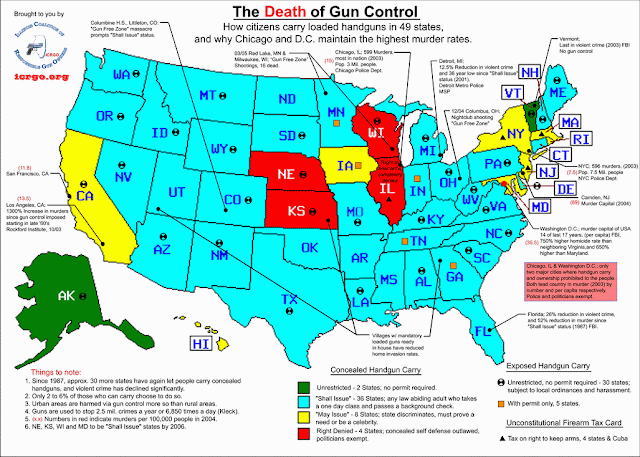
The school shooting in Newtown, CT was a tragedy.
I certainly responded to it differently, though, than did many people, partially I'm sure because of my background.
I don't have children of my own. I don't teach at an elementary school, and in all honesty I don't always empathize well with people this distant from me. Our principal was in the hallway crying the afternoon of the shooting. I, on the other hand, was just thinking that these were people I didn't know. It was tragic for them to have died and horrific for them to have died this way, but these were people I didn't know.

Mass shootings like this both are and are not rare.
Since 1982 (source and source) there have been sixty-one mass shootings - at least four people killed by a single shooter - since 1982. Thirty years...sixty shootings...two a year.
That is both far too frequent to be ignored and far too rare to be of earth-shaking concern. Yes, we should legislate to reduce the chances of these events happening again, but we shouldn't focus on large-number killings to the exclusion of the far more frequent gun deaths that occur in drips and drabs - one or two at a time - all year long, every day of the year.
Mother Jones has done a great job of building a statistical profile of these sixty-plus events...
You can see an interactive map of all the events and a chronological listing of all the shooters and victims on Mother Jones's website.

After the weekend PHS put out two large banners and invited our students to sign them, messages and condolences for the people of Sandy Hook and Newtown, banners to be mailed to Sandy Hook so that they could...
Because they need to...
I have absolutely no idea why Sandy Hook would want our banners, no idea what they are going to do with our banners or all the snowflakes.
I remember reading about the impromptu memorial at the Oklahoma City bombing site, at the Murrah Federal Building. People of the community piled thousands of things...stuffed animals, photos, mementos, things...on the chain link fence surrounding the bombing site. The items from that fence were - and as far as I can tell still are - "cleaned, catalogued and used in some way that fits with the mission of the memorial."
With all that we've heard is being sent to Newtown - stuffed animals, cards, wooden angels, snowflakes, giant signed banners - the people there will have to make a decision of their own: whether to keep everything, throw it all away, or pick and choose what matters and what doesn't.
They don't need our banners adding to that burden.

On a spectacularly good day in the United States, a dozen people are killed with guns.
This is where we should be focusing our policy attention. If we take the nineteen days of full data on that page as an average, we have 416 killings - an average of 22 a day. In a year, that's more than 8000 people a day killed with guns in the United States.
This is the bigger tragedy and the one that should be leading our legislative conversations.
Thanks, as is so often the case, to NPR for pointing this post out.

The Journal News in Westchester and Rockland counties of New York published an interactive map of every person possessing a legal pistol permit in those counties. It isn't necessarily a map of handguns or handgun owners, but it is permit holders.
The public reaction was interesting and almost universally negative.
I certainly responded to it differently, though, than did many people, partially I'm sure because of my background.
I don't have children of my own. I don't teach at an elementary school, and in all honesty I don't always empathize well with people this distant from me. Our principal was in the hallway crying the afternoon of the shooting. I, on the other hand, was just thinking that these were people I didn't know. It was tragic for them to have died and horrific for them to have died this way, but these were people I didn't know.

Mass shootings like this both are and are not rare.
Since 1982 (source and source) there have been sixty-one mass shootings - at least four people killed by a single shooter - since 1982. Thirty years...sixty shootings...two a year.
That is both far too frequent to be ignored and far too rare to be of earth-shaking concern. Yes, we should legislate to reduce the chances of these events happening again, but we shouldn't focus on large-number killings to the exclusion of the far more frequent gun deaths that occur in drips and drabs - one or two at a time - all year long, every day of the year.
Mother Jones has done a great job of building a statistical profile of these sixty-plus events...
- 49 of the 62 listed shooters obtained their weapons legally
- 103 of the 145 total weapons used were semiautomatic handguns or assault weapons
- gun ownership - as a percentage of population - is declining while gun ownership - as a measure or total guns owned in the US - is rising...perhaps people are becoming more set in their gun-owning, gun-stockpiling ways
You can see an interactive map of all the events and a chronological listing of all the shooters and victims on Mother Jones's website.

After the weekend PHS put out two large banners and invited our students to sign them, messages and condolences for the people of Sandy Hook and Newtown, banners to be mailed to Sandy Hook so that they could...
Because they need to...
I have absolutely no idea why Sandy Hook would want our banners, no idea what they are going to do with our banners or all the snowflakes.
I remember reading about the impromptu memorial at the Oklahoma City bombing site, at the Murrah Federal Building. People of the community piled thousands of things...stuffed animals, photos, mementos, things...on the chain link fence surrounding the bombing site. The items from that fence were - and as far as I can tell still are - "cleaned, catalogued and used in some way that fits with the mission of the memorial."
With all that we've heard is being sent to Newtown - stuffed animals, cards, wooden angels, snowflakes, giant signed banners - the people there will have to make a decision of their own: whether to keep everything, throw it all away, or pick and choose what matters and what doesn't.
They don't need our banners adding to that burden.
On a spectacularly good day in the United States, a dozen people are killed with guns.
- January 1 - 24 killed
- December 31 - 20 killed
- December 30 - 26 killed
- December 29 - 32 killed
- December 27 - 35 killed
- December 18 - 12 killed - the quietest day since Newtown, four days later
Slate has been tracking these deaths every day since Newtown. They show the deaths in icons, male and female, adult and child symbols.
This is where we should be focusing our policy attention. If we take the nineteen days of full data on that page as an average, we have 416 killings - an average of 22 a day. In a year, that's more than 8000 people a day killed with guns in the United States.
This is the bigger tragedy and the one that should be leading our legislative conversations.
Thanks, as is so often the case, to NPR for pointing this post out.

The Journal News in Westchester and Rockland counties of New York published an interactive map of every person possessing a legal pistol permit in those counties. It isn't necessarily a map of handguns or handgun owners, but it is permit holders.
The public reaction was interesting and almost universally negative.
The map is just information. It isn't condemnation. It isn't celebration, but people clearly saw it as one of those depending on what they brought to the information.
Personally, I view this the way I view most sunshine laws. Sunshine, in general, is good. Everyone benefits from sunshine on the dirty cracks and actions, and anyone who is committing good actions shouldn't be worried about a little sunshine.
We require registration for legal ownership of guns. As long as we do that, any records such as these are public - to be seen by any of us.
- How about a map of the editorial staff and publishers of Gannett and Journal News with names and addresses of their families...
- This is CRAZY!! why in the world would you post every licensed gun owner information?? What do you hope to accomplish by doing this. This is the type of thing you do for sex offenders not law abiding gun owners. What next? should i hang a flag outside my house that says I own a gun? I am canceling my subscription with your paper today!!!
- So should we start wearing yellow stars of david so the general public can be aware of who we are??
- We live in a free society. I am not at all ashamed of my ownership of a few handguns. While I understand the right of the local newspaper to post this, given to them by the first amendment of the very constitution that gives us legal license holders the right to possess the firearms they have published for all to see. While I totally agree (in principle) with their right to access this information, I think that the actions and reasoning behind this are not only questionable, but as a subscriber to their local newspaper, I think its irresponsible to post this information.
- Yeah, but where are the Jews, gypsies, homosexuals, Communists and Unionists?
Personally, I view this the way I view most sunshine laws. Sunshine, in general, is good. Everyone benefits from sunshine on the dirty cracks and actions, and anyone who is committing good actions shouldn't be worried about a little sunshine.
We require registration for legal ownership of guns. As long as we do that, any records such as these are public - to be seen by any of us.

From Greg Easterbrook on ESPN...
"Today, the number of concealed-carry permits is the highest it's ever been, at eight million, and the homicide rate is the lowest it's been in four decades."Cause and effect is notoriously difficult to guarantee and notoriously easy to misread.
Both facts are true -- but does one explain the other? Read this remarkable pre-Newtown article that escaped notice because it ran in a Saturday edition of The Wall Street Journal (Saturday is the week's lowest readership day). Shootings, the Journal reported, have risen almost 50 percent in the United States during the past decade -- which ought to be perceived as a shocking increase in gun crime. Yet homicides are declining, because fewer people who have been shot are dying of their wounds.
Improved medical care, the proliferation of hospital trauma centers and more helicopter ambulances are among factors improving the odds that a gunshot victim will live. Unlike on TV shows, where a bad guy who is shot expires instantaneously, an adult gunshot victim may survive the initial trauma. If bleeding is stanched and the victim reaches an emergency room in the "golden hour" before complications, chances of living are favorable. Especially important to improved survival of gunshot victims, the Journal reported, is that large numbers of medics who served in Afghanistan and Iraq have come home and taken jobs as EMTs. They have all-too-realistic training in keeping gunshot victims alive -- something the Army and Marine medical staffs have gotten much better at.
It may be that research and training on ways to save people hit by bullets represent an unintended consequence of the wars in Afghanistan and Iraq. But two and two usually equal four, and putting these two articles together suggests it is medical progress, not the proliferation of guns, that is the first cause of declining homicide rates.
Increase in gun ownership and a decrease in gun deaths at the same time doesn't necessarily mean that one lead to the other.
As always, post hoc ergo propter hoc.

From JoBlo.com...
and a re-edited version...

Final thoughts...
- I have never owned a gun. I have only shot an air rifle and then at empty cardboard boxes a few times nearly thirty years ago. I don't come from guns. I don't know or understand guns. I don't feel afraid in my home.
- We must eliminate guns from our society - real guns, fictional guns, toy guns.
- Legislating real guns retroactively is going to be amazingly difficult to get short of prying them from gun owners' cold, dead hands.
- I understand that the second amendment guarantees the right to bear arms, but that doesn't mean that we have the right to bear assault weapons.
- When the second amendment was written and ratified, we had just come out of a war with a King, we had just overthrown a tyrant and wanted to ensure that we didn't have to do it again. I'm not sure we have that same need at this point. It seems blasphemous to suggest overturning an amendment to the constitution, particularly one of the bill of rights, but I'm pretty close to saying that we need to do just that.


October 9, 2012
Indeterminate

That's what the recently-released Ohio Auditor of State's INTERIM Report on Student Attendance Data and Accountability System announced Princeton High School's status to be.
A little background here...
Every student in Ohio is required to attend school. That's not terribly different from it is in most every state in the Union. Each state has a few loopholes that allow parents to pull their students from schools if they can show that they're being responsible for their child's education - filing educational plans with the local school board, stuff like that.
Because of this requirement, each school is required to demonstrate that they are definitively educating each student in their district. If a student is assigned to a school, they stay assigned to that school until there's proof that the student has been assigned to a new school. You can't, in other words, withdraw a student until their new school enrolls them - meaning until you get a request for records from that new school.
Seems pretty straight forward, sure, but there are two complicating factors, both of which are part of the state report card for schools: attendance and state testing. Every school is 'graded' on a series of factors, most of which are based on various state-wide tests (10th-grade science, 4th-grade math, 5th-grade reading, etc) with attendance and graduation rate thrown in for good measure. We have to test every student in our building, but we only have to count the scores of the students who are 'ours' for 120 consecutive days - from the end of September through the March testing dates. If a student scores poorly on the state test but hasn't been with us for 120 days, that score doesn't count for us. This, then, gives schools incentive to err on the side of over-removing low-scoring students who have less than constant attendance to keep our state testing percentages as high as possible - while also giving us an incentive to (sometimes) under-remove students because we need attendance percentages of at least 93%.

'Indeterminate'
Apparently things like this have been going on all over the state - definitely in Lockland which was officially announced as having fudged their attendance/testing numbers this past year and whose cheating has set off a fire storm of investigation by the Auditor's office. The Auditor's office developed a list of one hundred schools whose statistics - students tested, students whose results were cleared - suggested that they needed a second look. Alphabetically, Princeton High School was #73 on that list (linked above) which meant that Princeton was visited by staff from the Auditor's office for a week or so who asked questions regarding our attendance recording.
This wasn't ever officially discussed with the staff or anything. We just...you know...heard about it here and there and got to read the following announcement on the district website...
STATE AUDITORS REPORT NO EVIDENCE OF ATTENDANCE TAMPERING
The Princeton City School District was notified on September 4 that the office of Ohio State Auditor Dave Yost wished to review our procedures and supporting documentation for student attendance for fiscal year 2011 for Princeton High School. Princeton, along with approximately 100 other schools in the state, was selected due to our high mobility rate that resulted in a large number of students not meeting the criteria for Full Academic Year (FAY). Only students that are continuously enrolled from the first week in October through the week of state testing are considered to meet FAY and have their test scores count on the district report card. The complexity of urban school districts, as well as those districts adjacent to them, is not widely understood. These school districts often have high rates of poverty and homelessness that may result in families having to relocate frequently. Additionally, Princeton serves as the fiscal agent for a juvenile court facility. These attendance files and records are property of the facility, and Princeton does not have access to these requested records.
While the financial auditors assigned to this work had no experience with this type of paper audit and the types of documentation they would encounter in the process, they were open to learning about the complex system of paperwork surrounding the lives of many students and families in school districts while still managing student confidentiality. The state auditors were present in the school district for five days reviewing student records to verify enrollment and withdrawal of individual students. No evidence of attendance tampering was identified. Princeton staff appreciates the suggestions from the auditors for improved efficiencies for the management of our paperwork and will begin to improve our systems immediately.

And then the big INTERIM report came out and broke the schools down into various categories: 'Schools With Evidence of Scrubbing' (36 of those), 'Schools With Errors' (28 of those), 'Clean Schools' (21 of those), and 'Schools Indeterminate as of the Date of This Report' (15 of those). That last category is the one where I'd like to spend a little time today because there are two schools that are sort of near and dear to me and mine in that category: Hamilton High School and Princeton High School.
Here's what the Auditor's INTERIM report has to say about that last category of schools...
The following table describes the schools where enrollment testing for the 2010‐11 school year is still indeterminate due to factors outside AOS control (e.g., schools are still gathering student information files and other information to support enrollment) as of the date of this report

With all this hullabaloo, all this kerfuffle, all this turmoil and tumult, all this brouhaha, all this upheaval, of course, the report cards for the 2011-12 school have yet to be released - at least a month later than they've always been released in the past years.
(Source - WVXU)
October 8, 2012
Today's quote...
 From the Friday News Round-Up on The Diane Rehm Show this past Friday...
One interesting statistic about this recovery... If you have a bachelor's degree right now in America, your unemployment rate is 4.1%. If you have a high school diploma, it's 8.7[%]. If you don't, it's 11.3[%]. The relationship in our economy, in a globalized, competitive economy between education achievement and job placement has never been tighter. ~ Major Garrett, National Journal (4:30 in at link above)If ever there was a strong piece of evidence that education should be pursued...
August 19, 2012
Back to School Boot Camp
Only minor and bleeped
 moments.
Some advice to the folks going back to school...doesn't really matter what level of school that is.
June 27, 2012
Another project

Over the summer I take a couple of weeks and travel the country - this year to Indianapolis and Houston - to help lead workshops for the ASM Foundation in spreading the gospel of material science.
We show a lot of videos during the week - partially because it's a great way to start the morning and bring the teachers back from our various breaks. If they're straggling a minute or two, they miss the video and can hunt it down on their own. It's not losing lab or lecture time.
Some of the videos are embedded in the powerpoint presentations that we use to guide the week, but others are just ones that we like and that somehow illustrate materials science and/or an educational philosophy that we are trying to spread. Particularly for those latter videos - and for the ones that we find throughout the year - I didn't want them to slip through my fingers or to be lost to the workshop attendees.
Here's to hoping that this blog helps with those goals.
Subscribe to:
Posts (Atom)