Showing posts with label commentary. Show all posts

November 11, 2014

Veterans Day Memories

Reposting from 2006

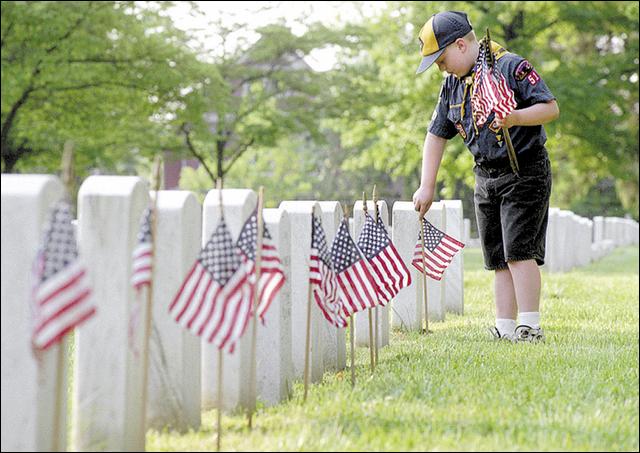
The picture shows a Cub Scout placing flags at the gravestones in the New Albany National Cemetery, my home town. It's one of one-hundred twenty-three national cemeteries, but it's the one that's clearly closest to my heart.

It was across the street from my elementary school, diagonal from my junior high, and probably three blocks from my high school. I spent many a time walking along the walls of the cemetery or walking beside them instead of on the walls when, for a time, I would choose to express deference toward those fallen and intered there. I never remember playing through the cemetery as I remember some friends doing, and the rare cuts through the cemetery were always oddly solomn for me, even though it wasn't anything resembling a spooky cemetery. There were nice, huge, old trees here and there, but the world was just outside the low walls, and nothing every was scary there to me.

And in 1991 my grandfather, a veteran of two American wars, was intered there. It is ther first funeral that I'd been through, and it just might still be the only one I've been through. He lived to a ripe of age - seventy-two - and certainly didn't die as any result of his service time, but it was comforting for the few years after that when I still lived in New Albany to know that I could stop by and see his gravesite at any time, nestled there among the rows and rows of identical headstones marking the graves of so many veterans and their families.

Today is Veterans Day, a time to remember how much has been given to us for what our country is today. No matter your feelings for the policies of the current administration - and mine are often negative - no matter whether you believe in the conflicts into which our current military men and women are being sent, remember to honor them for their sacrifice. Without those sacrifices, our country would not be what it is today.

Take a minute to thank a veteran today. Visit him or her. Stop by a memorial - the Chris Dyer memorial. Or simply pause your assuredly hectic life for a moment and thank them silently.

To know more about the New Albany National Cemetery, see any of these links:
Thanks, Grandpa...
Thanks, Chris...
Thanks each of you...

March 13, 2014

Comment of the Day

On my post regarding Ukraine and Crimea, the following comment was posted...
INCLUSIVE SALVATION

Who are those who are included in salvation? All men who believe and obey what the apostle Peter preached on the Day of Pentecost are saved. It does not make any difference what denominational name is written on the church building where you worship, if you obey the gospel preached by Peter, then, you are saved, you are a member of the Lord's church, you are part of the church of Christ, you a member of the body of Christ, you are a Christian.

What did Peter preach?
1. Peter preached that Jesus was a miracle worker. (Acts 2:22)
2. Peter preached that Jesus was resurrected from the dead by God the Father.(Acts 2:24-35)
3. Peter preached that Jesus was both Lord and Christ.(Acts 2:36)
When the three thousand believe Peter, they asked "What shall we do?"(Acts 2:37)
4. Peter told them to repent and be baptized in order to have their sins forgiven.(Acts 2:38)

This is the same message Jesus preached. (Mark 16:16 "He who believes and is baptized will be saved....)

THE TERMS FOR PARDON ARE: Faith-John 3:16, Repentance-Acts 2:38, Confession-Romans 10:9-10, Baptism (immersion in water) 1 Peter 3:21

All who meet the terms for pardon are saved regardless of the denominational name on the church building.
YOU ARE INVITED TO FOLLOW MY BLOG.
It included a blog address and the poster's name, neither of which I'm going to mention here because I'm not sure this is a man who needs more traffic.

And I do think he might have missed the point of the original post which was pretty much to say, "hey, here's some info about Ukraine that I didn't know until quite recently."

March 18, 2010

Handsome gents


There aren't all that many gents that I feel comfortable saying are straight up handsome.  There are, however, a few...

March 17, 2010

Sports and me

It's basketball season, so that means I'll hopefully end up dropping fifty or so bucks - five at a time - to see the Princeton Vikes as they head toward what will hopefully be another appearance at the state basketball championship level.

Next game is tonight up at Xavier tonight as the boys take on their first Catholic school opponent, and I'll enjoy the heck out of it.

But I won't yell or scream.

It's not what I do when I'm at a basketball game...or a baseball game...or hockey... football... soccer... whatever.

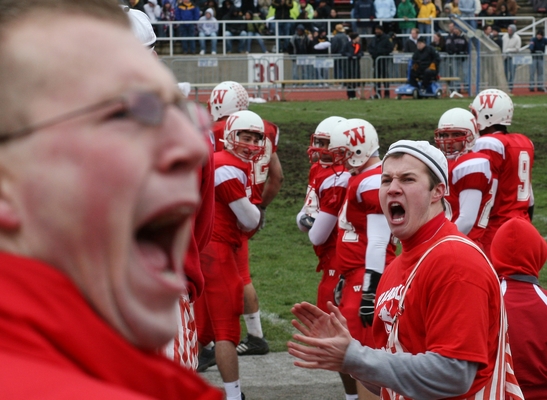
I'm all down with rooting for the Vikings and all - especially since I know students on both teams - but I know that my cheering, my screaming, my yelling, my whatevering probably won't have any sort of impact on the game.  And I gave up my screaming at the sports teams a long while ago.

I remember screaming when I was at Wabash.  We had a blast harassing the visiting players as much as we could, bringing whatever pots and pans we could from our fraternity house, banging the crap out of them with oversized spoons and ladles just to be as obnoxious as we could manage to be.

I don't know that we ever actually had any impact on the game, but we screamed and yelled and generally made jerks out of ourselves entirely.

And I haven't done that since.

I've enjoyed watching tennis matches and basketball games and even bowling - um, bowling whatever-they're-calleds.  And I haven't screamed much at all.

I don't wear a lucky shirt to watch ballgames at home.

I don't have idiosyncrasies or routines that I have to follow to make sure that the Vikes win. 

I'm much more likely to sit down way up high in the bleachers away from the rest of the fans, kick back, and enjoy the game than I am to sit down from and scream my head off.

I don't know where this attitude came from - admittedly my mom isn't exactly all that sport-oriented, but I remember my dad dropping a number of fricks and fracks whenever the Indiana basketball teams of the 1980s gave up a lead or didn't run the motion offense correctly, but I also remember one conversation in particular.

It was March of 1992 - seventeen years ago now - and the New Albany Bulldogs were in the regional finals in Seymour taking on the Jeffersonville Red Devils (kinda like this past weekend's game).  New Albany was my team, and the Saturday of regionals had become a fairly regular home.

Lots of people would get hotel rooms to party away the afternoon between the two morning games - 11:00 and 1:00 - and the night game - sometime around 7:00 - because there wasn't a whole lot of ways to pass the time in Seymour.  Some years I would go with my father and spend half the time eating at The Pines.  Other years I'd hang out with CoachSullivan, visiting with his family there in town.  I remember one year hanging with The Girl and our friends passing time in a cd & tape store (seriously, they had those back then) and Wal-Mart (seriously, Seymour's not exactly a happening place).

New Albany had drawn the second of the two semifinals that year, playing Scottsburg (I think).  This was always a disadvantage as it left the team with two hours less recovery time in turning around for the evening game.  I sat on the front row with my friends - we'd painted shirts spelling out something or the other - and I yelled like a madman at the referees, especially when one of the New Albany players was fouled and knocked to the floor right in front of the N'Albany student section.

By the evening, we were fully keyed up and ready for the Bulldogs to beat the crap out of the hated Red Devils - N'Albany's oldest, traditional rival.  I'm going to guess that both teams were ranked in the state - I really wish I knew all the details, but I can't find a website that provides the full tournament breakdown of every IHSAA tournament (something that's a crime in this the tourney's 100th year - Sully, a project for you).

The Devils beat the Bulldogs in a close-fought game that night, the last time that I would attend a game at Seymour and get to sit courtside with the students of one of the competing teams.  The New Albany team was made up of people I knew - not necessarily friends for the most part, but people I knew from the halls, people that I'd been around when I was the team statistician during my sophomore year - and they lost.

The good guys lost to the bad guys.

In my head, there was no other way to describe the situation:  evil won and good lost.

No, the Red Devils didn't really carry pitchforks or switchblades, didn't shout curses at the opposing players or their N'Alabny fans, didn't cheat or punch, didn't rape or pillage.  But they were the bad guys, and for some reason that bothered me.

My team was supposed to win.  We'd cheered our hearts out, given everything that a fan section could give (I understand now, of course, that the Jeffersonville cheering section had done the exact same thing), but it hadn't made a difference.  For some reason, that bothered me far more than it should have.  

When I got home that night - rode the hour or so with friends - my dad was already home and still up.  He probably wanted to make sure I got home safely.  He's like that.

I don't know how the conversation started, but I stayed up until one or two in the morning (the game had ended sometime around 9.  I'd gotten home around 11, I would guess.  The kernel of the discussion was my absolute certainty that New Albany was supposed to win, that my team was the good team and that 'we' were supposed to come out victorious because of that.

I just couldn't fathom why we hadn't, why the bad guy had won and why their season was going to continue in Terre Haute the next weekend while my team's season was done.  I remember being near tears at some points in the conversation because I felt so strongly, so absolutely that the Bulldogs were going to prevail.

No, I'd never seen New Albany win a state title (their only one came in 1973, two years before I came into being) or even go to the state title game (I have since seen that, thankfully), so I don't know where I got the absolute certainty about the outcome, but I knew what was going to happen.  It was my senior year, and things were going to work out for the storybook tale.  Everything was going to be right.

But it wasn't.

And something changed in my relationship with sports that night.  I didn't know it at the time, and I didn't feel it consciously, but something was definitely different.

No longer would I live or die with the outcome of a game. 

No longer would I be at risk of cursing or swearing at the television or the officials or the opposing players.

Instead, I would - and do - sit back and enjoy the game for the game itself.

Yes, I often have rooting interests - I want Indiana, Princeton, New Albany, Wabash, the Celtics, the Reds to win - but those rooting interests don't get in the way of my enjoyment of the being a spectator any more.

I applaud the opposing team's great plays and players - admittedly at a lower volume - and don't criticize the referees.  Neither the opposing players nor the officials are trying to cheat 'my' team, they are just trying to do right by their roles, and I appreciate them for that.

I'm not at the game to see Princeton win; I'm at the game to see a great game, and Princeton can't provide that alone.  For the great game, I thank the opponents and the officials, the opposing fans and everyone in attendance.

So when, last weekend, a colleague of mine leaned over from the seat behind me and asked why I was so calm at the Princeton-Fairmont basketball game, I simply replied "this is how I watch basketball".

June 18, 2008

Which graduation is right?

We're a few weeks past PHS's 2008 graduation, and I think now I'm ready to talk about what went down.

We sent about four hundred members of the Class of '08 across the stage at Cintas Center and handed each of them a diploma cover - to be filled in after the ceremony. There were a number of black-robed folks up on stage to escort them along - school board members, principals, central office folks, counselors - and the graduates were then ushered on along and down the steps on the far side of the stage.

I took up my usual and awesome vantage point right at the stairs up onto the stage, keeping the timing right, pausing the grads for a moment before they headed up, reminding them to spit out any gum so they'd look right in their picture, congratulating nearly all of them, and generally making small talk to calm the last minute nerves of - especially - the girls who chose to wear the high heels for the first time ever.

Everything was note perfect from the time they gathered at PHS, loaded the busses bound for Cintas, lined up in the small gym, headed to their seats, and stepped toward the stage.

And that's where the heart attacks started...

"The Princeton Way" of graduating is a rather formal affair. The students are arrayed in alternating rows of red and white with the top students, foreign exchangers, and senior a capella folks up front. We get a couple of none-too-thrilling speaches, and the grads head to the stage.

Their names are read, the live video of the ceremony is shown (now with their names below them in the shot) on the scoreboard up in the rafters, they shake a couple of hands, and head onward. Applause is - according to the principal's request prior to the ceremony - to be held until the final graduate's diploma holder is handed out. No one graduate is to be celebrated individually. Family and friends are not to single out any one over the others.

This year, however...

We got students throwing down their mortarboards (never knew why it was called that, huh), whipping their dreadlocks around, stomping across the stage, dancing, shaking, opening their arms to the heavens, and generally doing a lot more celebrating individually than communally, no matter the gentle hands of administrators trying to usher them along. We got parents - honestly no worse than in the few years past - who set off air horns, clapped and cheered, and yelled - some during the initial processional, some as their graduates crossed the stages, some during the speaches.

And then we got principals and teachers talking afterwards about how to fix the problem...how to make sure that doesn't happen again next year.

We'll give 'em community service hours if they demonstrate like that.

We'll make them pick up their diploma a month later if their parents carry on like that.

We'll warn them in advance of their punishment.

We'll make the parents sign a behavior contract are else they don't walk.

We'll limit the number of tickets so they don't just hand out tickets to any fool in our hallways.

And I'm a little bothered by that.

My dad and mom both graduated from high school before I did, and my sister was certainly headed that way when I matriculated from good ol' NAHS. Heck, Dad had even checked off the whole college degree thing - with a bonus masters, too. (Mom's college experiences apparently involved drifiting off each spring so she could play Dylan songs in the sunshine. Not exactly a plan for getting handed a sheepskin.) They didn't scream my name when I shook hands back as part of the class of nine-two.

They didn't even scream or yell when I got my Wabash diploma - and that one really was printed on sheepskin. Admittedly, Mom tried to embarass me a different way, but that's a tale for another day.

Stay on topic, man...

When I was a high school freshman, my dad sat me down - probably at Mom's insistance, I know the man - and asked me what my goals were for the next four years. Did I want to try for valedictorian? Did I want to get straight A's? What did I want to accomplish?

Nope, none of those. I told him I figured I'd do well enough, but straight A's and the #1 ranking weren't important to me. (I finished #5, right behind Lexi Shallers, not that I'm bitter...) I guessed I wanted to make the radio staff so I could be on air (two years, lots of hours on air, thank you very much).

Did I at least want to graduate and head to college, he asked?

Well, yeah. I thought that was assumed...my flip answer.

In my head, not graduating from high school wasn't an option. I was at least going to get that far and was pretty sure I was going to graduate from college, too.

So there was no reason to whoop and holler for me.

But...

And I feel almost condescending in saying this...

Not every one of the students who went through commencement on June 2nd at Cintas knew they were going to graduate.

Not every one of them could have been so casual with saying that they were going to get a high school diploma.

Not every one of their parents had one, not every one of their siblings had one.

Getting that diploma is a big deal for some of them, something to be celebrated for the years of hard work and struggle, for the acknowledgement by the massive institution of PHS that they accomplished something.

And I'm kind of thinking that they deserve a chance to celebrate, a moment to bask in their glory.

Sure, there's a part of me that wonders just how ready they are for the real world, how good a job we've done in preparing them - particularly some of our graduates who just scraped through with low graduation test scores, low grades, and just few enough discipline issues to make it onto that stage...

But how can we congratulate them but ask them not to celebrate?

How can we please the half (probably more, maybe 2/3rd) of the crowd who still wants that calm, dignified ceremony while still allowing the students to celebrate their moment?

Maybe we need to have a mock ceremony in which we show them what is and what isn't appropriate...but who's to make that decision, draw that line?

Is it okay for a kid to wave to the crowd?

To whoop once?

To cry?

To blow a kiss toward her family?

To blow a kiss toward heaven?

To stomp once?

Twice?

Add in a holler of yes?

I have no idea...I know it wasn't what I was going to do, but that doesn't mean much, and lord knows I'm far from the final arbiter.

And just when have things gotten so far out of hand that the principal really does step forward and do as he and his predecessers have threatened and shut down a graduation? Is it worth killing the ceremony for four hundred graduates and a few thousand friends and family just because a dozen people aren't behaving the way we want them to - not the right way, I won't go that far?

What if it's thirty people whooping and hollering?

What if every fifth graduate moonwalks across the stage?

Every other?

And would that be wrong if they did?


I don't, by the way, honestly have any clue how to solve this or even if it needs solving.

Your opinions are, as always, welcome.

June 5, 2008

This is the end?

It's an odd life that I lead.

I meet a hundred or so new people each August, hang out with them and get to know a lot of them really well for about nine months, and then we part ways. Some of them I get to see in passing the following year and others stay in contact for a lot longer, but many of them leave and pretty much never return to lovely Room 519.

It's a seemingly-endless cycle of hellos and goodbyes. Admittedly, at this point in the school year, there a few goodbyes that I'm more than happy enough to offer, but a lot of my students will be missed. Some of them - student aides, Pasta for Pennies folks - seem like they'll be completely irreplaceable, but someone always seems to step forward the next year to get the work done, and it's amazing.

My problem right now is that the school year - as we have it set up right now - is entirely lacking in closure as there is no specific last day of school on which we can say our final goodbyes.

About three weeks before the year ends, our seniors have their final day of regular classes, and some of them don't come back into the building.

Then, over the next few days, some of the seniors come back to take their senior exams - typically shortened versions of the underclass exams. And then they're done.

A week or so after that, the underclass students wrap up their regular class days and drift away. They can be exempt from their exams if they do well enough on grades and attendance, and others recognize that their exam grades don't affect their semester grades (C-C-anything ends up being a C), so those kids don't take their exams. Another group gone.

Then there's this week, a series of half-length days with two exams each day. Classrooms half-filled - or less - with students taking their exams like punishment, and by the end, they certainly aren't in the mood for the solid, heartfelt goodbyes that it seems appropriate to give them.

And the halls are much too empty to catch the ones I should've said goodbye to when I had the chance.

I miss the old ways, the full exams, everybody here until the very last. Everyone yelling and screaming their way down the hall on the final day.

Instead, we get a building that teems with life all year long slowly stripped of its vitality a few cells at a time.

Where's the dignity, where's the finality.

It's like watching a friend die a breath at a time.

Gimme my heart attack, my grand mal, my hit by a bus and died painlesly.

This fade to black doesn't work for me...

October 24, 2007

Thoughts on a passing


That's Joey Eger. He graduated from Princeton in 2005. He passed away this last Friday, killed by a train. It might've been suicide.

Today was his funeral, and I've been thinking lately about how the use of the the internet, in particular of Web 2.0, has changed our legacies. I certainly don't have anything profound to say about the subject, and definitely nothing that hasn't been said a dozen times by other folks out on the web, so please don't look for anything truly profound today (not that I frequently offer such words)...just a few thoughts...

On Sunday, I saw the following series of comments under the above video on YouTube:
  • avagrantmind: he died irl I think
  • avagrantmind: search for "joey eger" on google and look for like something from wkrc wcpo or local12 he got hit by a train
  • paintsmeblue: rest in peace <3
I don't have a clue who either of the commentors (sp?) are, but from their profiles, I'm guessing they were either friends of Joey's or friends of friends. Either way, the surrealness of a comment like he died irl I think shocks me. I'm still able to see Joey because he's right there on the video, right there on my computer screen.

And then there's the oddness of what will happen to his posted videos now that he's gone. There's nobody at YouTube who is going to take those down just because he's passed away, nobody who knows in the least that he's gone. His profile lists "last login: 7 days ago", and that's about the only thing that's going to change. As far as that page is concerned, Joey's just changed accounts or flitted his attention someplace else.

My family wasn't a home movie kind of family. I've got video of my dad somewhere around because he was on tv from time to time - he teaches a government class in which they cover local elections and interview candidates - and I've got one of me teaching a class when I was in college, but I don't know that I've a single video of my sister or mother, and I know I don't have one of The Girl anywhere. We're all just a little too old to do what Joey did and video tape some stupid evening, some dumb afternoon, and throw it out there for the whole world to see. I guess there are a couple of me on my school site, but that's about it. Joey will live forever, weirdly, on YouTube. I don't know if that's a good or a bad thing. It's a thing.

I did what the second commentor suggested. I searched for "joey eger" on google. Here's hit #2. She apparently lived below Joey. She must've known him because she's got a great picture of him.

...

The funeral today was impressively moving, particularly when Joey father and brother played "Amazing Grace" on guitar and violin. The ceremony offered what most folks there needed - a time to grieve and say goodbye, a community of mourners. The funeral is the right place for that, we're all sad but sad together.

I'm pretty firmly a atheist (or, at best, an apatheist), and it got me to wondering what's going to happen when I slip this mortal coil. I would like to think that there will be some people who would like that same sort of time to grieve my passing, but where would such a place be, what would such a ceremony look like for an apatheist? The Catholic religion does a marvelous job of providing people comfort and routine/ceremony on which they can rely, allowing their body to go on auto-pilot while they grieve.

There are actually a number of times that I wish I had that same faith, that belief that there was some higher power guiding us, that we would eventually be redeemed in some fashion, but I don't have it. I wasn't trained into it, and I haven't found it on my own.

...

Joey's the third student of mine that I've known to have died. The first died while I was still his teacher. It was my first year in Terre Haute, Indiana, and I don't even remember his name. At the time, I couldn't have told you anything about him other than his name, his grade, and what he looked like. I don't think I knew a single thing that he was interested in or a hobby that he had. I had no clue who he was. He died in a car accident one weekend that year.

The second was Chris Dyer, a student that I had for two years, both of whose sisters I taught. Chris died a Marine's death a year or so after he graduated from Princeton. He was in Iraq and had a fully military funeral when he came home. His parents used the death benefit money to set up a scholarship given to a Princeton student each year. I've known both recipients of that scholarship. I was closer to Chris than I was the other kid. I knew Chris.

Joey falls somewhere in between. I certainly knew who he was, and I knew of a lot of his hobbies. He was a goofy kid in high school, and he had a few challenges in college as he had a couple of alcohol violations in his dorm and had to go through some prescribed counseling program. As you can see in some of his other videos, he was a part-time rapper and an idiot who was willing to do just about anything on his way off a diving board. I've had dozens of students that I've known better than I knew Joey, but I at least knew something more about him than his grades (which weren't, admittedly, always the best in my class).

I don't know that I'll actually miss Joey, as I rarely thought of him unless somebody else mentioned that they'd seen him or heard from him recently. His passing won't exactly leave a void in my life. There are always cliches - all true - about it being tragic when a young person dies, but it happens all the time. Horrible people and wonderful souls get struck down just as easily.

I wish I had something more profound to say.

I wish I had one last chance to say something to JoJo, the decidedly not dog-faced boy.

I wish I could help his brother, whom I have in class this year, and lots of their friends who I saw crying at the funeral today make sense out of any of it.

G'night, Joey.

G'night, folks.

April 19, 2007

The issues of celebrity


Arrggh...

Where to start from this video...Kimmel's unwillingness to let his guest speak...the dopey ignorance of his guest - unwilling to understand the seriousness of the issue...the stupidity of a website/company in sending this ditzy girl to defend their business...the continuing deterioration of private space...Kimmel's far-too-personal take on the story..."...citizen journalism, people don't read it with the expectation that every word of it will be gospel. Everyone who reads it knows that it isn't checked at all."...the fact that Kimmel seems to be filling in for Larry King, which mystifies me...the hugely blank, dopey face and chuckles from the girl at the end...

Or, the real kernel...

"Honestly, I think there is a shifting definition of what is public and what is private space for everyone, not just for celebrities. The internet, blogs, MySpace...no one has the reasonable expectation of being able to walk down the street and not have what they're doing be noticed by someone anymore."

"Well, that's just the terrible thing, though, isn't it?"

"Is it really? I mean, I think it's great that we're not putting people up on a pedestal and worshiping them anymore."
Ok, folks, there's the real rub.

We no longer have private space unless we are locked up in our house with the windows drawn and the firewall turned up to the max. The moment we step onto the front porch or into the back yard, the moment we take out our trash, the moment we lean toward the windows, the moment we log onto the internet and send our email into the magical ether, we are giving up that privacy.

And I hate that fact.

I hate overhearing the conversation of the jerk at the check out in front of me at Wal-Mart because he won't put down his cell phone while he's paying.

I hate seeing the bluetooth ear phones in people's ears while they wander the stores and schools where I have to be.

I hate that the line between what is public and what is private has faded into near oblivion with the advent of cell phones, digital cameras, telephoto lenses, wireless technology, and every other technological development that is supposed to be making our lives easier.

Yes, I answer my work email at school and while I'm out of town.

Yes, I pruriently look at two celebrity stalker blog websites regularly.

And lord knows that I post my daily thoughts onto a blog for everyone to see.

I am not without sin in this miasma that I decry, yet I find it more and more necessary to throw stones at this glass house.

Let me make a small first step, and I then I will a few other small steps that you can pick from to take that small step along with me.

I pledge from here on out to delete the links to the celebrity stalker blogs that I check with some regularity; to not refind those sites; to not buy (not that I ever really did) any magazines such as Us Weekly or People - magazines that depend entirely upon telling us the intimate and private details of celebrities.

Now, what can you do to take small steps away from the abyss?
  • Promise to end all cell phone conversation before you approach a restaurant counter, a store check out, or a drive-thru window.
  • Promise to leave the cell phone in your car when you go into any business.
  • Take the bluetooth earphone out of your ear when you aren't using it.
  • Stop talking into the air because you've got a cell phone earpiece in unless you are alone at home or in an office.
  • Don't talk about the private lives of any of the following people: Brad Pitt, Jennifer Aniston, Angelina Jolie, Jake Gyllenhall, Heath Ledger, or anyone who you have not personally met or spoken to.
  • Don't watcht E! News, Entertainment Tonight, Access Hollywood, Extra, or Showbiz Tonight.
  • Don't post videos on YouTube or any other site unless you know the person in the video personally, have gotten their permission to post the video, and know that in ten years they'll be happy to have put that image of themselves out there.
Please, help me to stop the madness...

February 26, 2007

The Perfect Basement

Just back from a long weekend in Gatlinburg - Pigeon Forge, honestly - and from remembering how spectacular pink pong is as a sport. I totally dig ping pong, and I love playing with just about anybody...and that last part can be a bit misleading.

I loved having a ping pong table in the chalet, and I dug playing ping pong the half dozen times that we played. That sort of thing makes me almost forget that playing ping pong solo isn't the same as having somebody around. When my family moved into our new house - 'round about my freshman year in high school - we got a ping pong table, and I got pretty good at it 'cause I got to play against my parents - both pretty decent - on a regular basis. Then I headed to college and got to play ping pong in the basement of the frat house for most of my freshman year (after that I had to do some actual work and got my own room, doncha know).

But then I moved away, and the girl certainly isn't into ping pong, so I don't play nearly as much as I'd like to.

Of course, my basement doesn't really have the room for a ping pong table - at least not the way it's set up now - but I did get to thinking about what sorts of stuff would make up the absolutely perfect basement.

Your thoughts?


January 31, 2007

Nominee for worst website #2

Websites are meant to convey information. Sure, they can also be pretty and neat and cool and all, but above all else, their major purpose - the conveyance of information - should not be lost.

In the past, I have ranted against Chipotle's website because it's neat but has loads of features that actually make it harder to get information out of their site rather. Don't get me wrong, I dig Chipotle's food and their willingness to give to their community. I just hate their website.

Today's rant is about another tragically craptacular website, that of Harry Potter author JK Rowling.

First there's the annoying requirement that the site launch automatically to fill my entire screen when the actual content only takes up about a quarter of my screen's resolution.

Second, there are a number of pointless animations that go on within the screen - butterflies, spiders, general crap - that draw the eye from whatever content is actually being focused upon.

Next there's the fact that the site uses mystery meat navigation. I have no clue what's going to happen when I click on the hairbrush or the wristwatch, or the cell phone, or the diary, or the business card, or whether any of those things are actually clickable until I roll over them. One thing - the eraser, for example - even shows a question mark upon roll over, confounding me even further.

The glasses point to the links page. The hair brush toward the extras page - whatever the heck that's for.

I know Rowling is a creative person (or at least assume she is - I enjoy her books and would rather think that she's writing great stories out of creativity rather than our of some cold, calculating plan to simply harvest great boatloads of cash), but that does not give her license to hire somebody and encourage them to create a website that does little more than confound.

So, nominee for worst website #2, J.K.Rowling Official Site.

Congrats, JK, your site sucks.

January 28, 2007

I may be unwell

There are a number of things wrong with our world. Many of those things are nearly entirely out of our control. I don't know, for example, what I can do to stop genocides in Africa, suicide bombers in the Middle East, or even the problems associated with poverty in the US. I do know, however, that there are problems that you and I can very easily begin to make a difference with.

One of the latter problems is the the continuing - and worsening - underbelly of our meat production industry. The more I learn, the more horrified I am at the realities of how the chicken, eggs, beef, and pork gets from the hoof to my local grocery stores.

The image that we all hold of a farm is one of bucolic serenity, a gorgeous white farm house with nice red silo and white rail fences holding in a half dozen cattle free to wander a grassy yard edging up to a mud pit where pigs roll about in the mud, nudging themselves around playfully. All of this, of course, takes place against a backdrop of a field of corn that has kids playing between the rows, popping their heads out from time to time.

The realities of modern farms, however, are much, much different. Most of them are factory farms throughout the United States (and in many other countries of the world) is one of huge covered sheds that would span numerous football-fields, housing thousands and thousands of either chickens or hogs living in such close quarters that the sheer concentration of their wastes lead to chemical burns and an environmental disaster of near biblical scale. Animals are kept in horrible conditions, living lives of constant suffering from the moment of their conception until their eventual journey to the slaughter house.

At those slaughter houses, then, the conditions have not much improved since Upton Sinclair's The Jungle. Admittedly, some people have attempted to overhaul the processing of animals, but many slaughterhouses are still run at such ridiculous speeds, demanding such levels of production from their workers that it is almost impossible to maintain sanitary conditions and worker safety.

In eating much of the food that we eat, we sacrifice our environment, our moral responsibility to treat animals humanely, and our responsibility to other humans to allow them to work in safe conditions.

And I continue to love steak and burgers and chicken sandwiches.

I have not done nearly enough to do my part in changing the industrial landscape, and every time I go to the grocery store and see the coolers filled with unethically-produced meat, I feel a pange of guilt.

And I need to start to change that.


If you want to know more about my topic today, head to the following websites or read these books:
  • The Meatrix - a cartoon introduction to many of these issues
  • Fast Food Nation - a book by Eric Schlosser that details these issues while also addressing their impact on the ever-growing American waistline
  • Chew on This - Schlosser's follow up written for teenagers covering much of the same landscape with a slightly easier writing style

January 17, 2007

Big Red and the court of public opinion

Excerpt from Mark McGwire's opening statement to the Government Reform Committee
"What I will not do, however, is participate in naming names and implicating my friends and teammates. I retired from baseball four years ago. I live a quiet life with my wife and children. I have always been a team player. I have never been a person who spread rumors or said things about teammates that could hurt them. I do not sit in judgment of other players, whether it deals with their sexual preference, their marital problems, or other personal habits, including whether or not they use chemical substances. That has never been my style, and I do not intend to change this just because the cameras are turned on.

Nor do I intend to dignify Mr. Canseco's book. It should be enough that you consider the source of the statements in the book, and that many inconsistencies and contradictions have already been raised.

I've been advised that my testimony here could be used to harm friends and respected teammates, or that some ambitious prosecutor can use convicted criminals who would do and say anything to solve their own problems and create jeopardy for my friends.

Asking me or any other player to answer questions about who took steroids in front of television cameras will not solve the problem. If a player answers no, he simply will not be believed. If he answers yes, he risks public scorn and endless government investigations. My lawyers have advised me that I cannot answer these questions without jeopardizing my friends, my family, and myself. I intend to follow their advice.”
The above quote - originally spoken very carfeully by Mark McGwire in front of a Congressional committee self-charged with rooting out the evils of steroid use in baseball - came to me from an article on The Hardball Times exploring the results of the recent election for the Baseball Hall of Fame.

The article points out a number of inconsistencies among the results. For example, the author questions the disparate vote totals of Steve Garvey and Don Mattingly; Jim Rice and Dale Murphy; Albert Belle and Jim Rice; Alan Trammell, Lou Whitaker, and Lance Parrish. The major thrust of the article, though, is the voting results for Mark McGwire. In an earlier article, the author wrote his belief:
If I had a vote in 2006, I’d vote no. Not because I don’t feel he belongs, but because I think we need a bit of perspective before we come to a firm decision. He has 15 years to be on the ballot. During that time, hopefully more information will come to light. How long did McGwire use? Generally, how much did the “juice” skewer offensive stats? Was he a borderline player who got pushed over the top by it, or was a Hall of Fame talent who simply goosed his totals a bit? How are the non-player enablers of the steroid era treated by history?

Right now it’s too early to tell. A mistake Hall of Fame induction "stands forever in the guide." A player mistakenly left out can always be put in.

If a mistake is to be made, let it be a reversible one.
His argument is that we don't yet know what we should do about Mark McGwire, not enough time has passed. We should take time, evaluate what did or didn't happen, and how that should color our view of McGwire's legacy. Until we do that, we should err on the side of keeping him out - a "reversible [mistake]".

I disagree, because of another statement that the author makes in his article:
Never forget this: as to the statutes of major league baseball as they existed from 1986-2001, Mark McGwire broke no rules.
I can even ignore the next few statements:
He played in an environment where players were encouraged to use steroids. Management lavished huge contracts on players who could crush the ball regardless of how they managed to do—no questions asked. Jason Giambi’s agent, Arn Tellem, asked the Yankees to remove a clause that could cause the contract to be voided if Giambi was caught using steroids. If Tony LaRussa knew of Jose Canseco's steroid use then he probably knew about McGwire too—however he never notified his bosses so they could invoke the "probable cause" rule and have him tested.
To me, that isn't nearly as relevant. Yes, McGwire was playing in a time where the administration of the game was in a very permissive mode. The kernel of the argument to me is very simple - Mark McGwire broke no rules.

Every baseball fan during the summer of 1998 watched the epic home run chase between McGwire and Sammy Sosa with eager anticipation. There have been entire books written about that summer's baseball drama, and I would argue that only the most naive of baseball fans truly believed that the transformations of both sluggers - from their lithe, agile rookie seasons to the mammoth, muscle-bound sluggers of the 1998 season - came about without the assistance of some non-prescription aide.

We watched. We drooled. We turned a blind eye and didn't give a diddly darn what those two were eating, drinking, shooting up, or freebasing behind closed doors. We didn't care. Baseball had done us wrong five years before, and we were just happy to be able to turn back to the sport that so many of us had turned out back on.

(Let me be clear on that: baseball did not turn its back on us. It changed. That was inevitable. It is we who put the expectations of what we want baseball to be who turned our back on the sport. Baseball owes us nothing. We are stupid enough to invest our hearts and souls in groups of men who are doing nothing more than a job. Sure, it's a job they enjoy, but it's their job. If we're stupid enough to continue to throw money at them - buying tickets and stadia - without any express, written contract of what they have to do fur us in return, then we deserve to get exactly nothing in return. I love baseball, but it owes me nothing whatsoever.)

And then that summer's two heroes turned out to be less than the perfect Adonises (sp?) that we had wanted them to be. Our heroes fell from Olympus and turned out to be imminently human. Sosa corked his bat and shrank before our very eyes. McGwire, however, went out an untarnished hero - forgoeing a contract extension and retiring when we wanted him to retire - while he still was able to amaze us with his titanic home runs.

But then we called him back. We asked a very private man to stand before us and humble himself. We had all but convicted him in the court of public opinion, and now we wanted his contrition. We wanted him to either come to us head bowed, asking for our forgiveness or to betray his teammates and competitors by naming names, taking down so many of our other heroes on his own so that we didn't have to.

And he would do neither.

So, we convicted and hanged him anyway.


If you have any interest in the Baseball Hall of Fame, please take a little time to read Bill James's outstanding - if now a bit dated - book Whatever Happened to the Hall of Fame?, originally titled The Politics of Glory.

January 4, 2007

Celebrate anonymously, please

Last night, I found myself behind a big SUV being driven - I assume - by a proud papa of two young soccer players: Erinn & Danielle. The proud papa also had on his SUV a license plate holder pointing out that his child was an honors student at Bloomfield Elementary on the back of the SUV monstrosity.

Now, about a month ago, I probably wouldn't have given the sticker and license holder a second thought. But that was before my wife pointed out a little something that she learned when she was in elementary school. It was in the early part of her elementary school career that Adam Walsh was kidnapped from a department store in Florida. Somewhere along the line after that kidnapping, an adult mentioned Adam's name to my future wife and told her how important it was for parents to not provide information about their children to strangers.

Every bit of information about a child that is randomly given to the world could just as easily be being given to a pedophile who might use that information in the future.

Preventing such information from getting into the wrong hands is along the lines of not letting underaged kids put their names and pictures out on the internet, telling them not to talk to strangers, and to not go anywhere with anyone other than their parents (and, sadly, sometimes not even with those in cases of estrangement and divorce).

So, the next time a friend of yours slaps a big softball sticker on the back of their car celebrating their three kids who play softball, remind them to at least not include their names. You'd be surprised how many of those stickers end up right next to another one that says which school they go to.

It doesn't take much information to do something bad...

January 3, 2007

Vanity plates

I miss vanity plates.

I don't mean that I miss seeing them. That's certainly not the case as there are more and more of them on the roads these days than ever before.

What I miss is the name vanity license plate. It had a certain pejorative connotation that I miss. The phrase personalized license plate doesn't have that same sort of negative feeling. It seems much more acceptable, much less vain, and I don't like that change.

I liked that when I grew up, anybody who had a non-random license plate was vain. Now they're just choosing to express themselves - something I've mentioned my disdain for in the past. We don't need to know what you think. We don't need to know who you are, what your job is, or what you think is funny at every moment of your day.

Don't put it on a t-shirt.
Don't put it on your bumper sticker.
Don't slap a magnetic ribbon on your car.
Don't put it on your vanity plate.
Shut up.

And if you're really desperate to tell everbody what you're thinking every moment of your life, start a blog. At least that way only the people who care have to read it.

December 19, 2006

Under the weather

Why, he's the poorest, clumsiest excuse of all the creatures that inhabit this earth. He has got to be coddled and housed and swathed and bandaged and upholstered to be able to live at all. He is a rickety sort of a thing, anyway you take him, a regular British Museum of infirmities and inferiorities. He is always undergoing repair...He has just that one stupendous superiority--his imagination, his intellect.
~Mark Twain, a Biography

Mark Twain's quote points out that the human condition is one in which we are often fighting off infirmities and inferiorities - illnesses both physical and mental.

I don't quite think that is the case, however, and my recent bout with illness (cold chills, headache, sore throat, general fluishness) left me a few moments to wonder about this very concept.

We are an incredibly hearty species. We came from a dessert climate, down from more damp forests, and have spread into every possible nook and cranny of our planet, finding ways to survive the harshest colds and heats, the wettest and driest environments that we can manage - often just so that we will know that we managed them.

We have not been laid low - for long, anyway - by the most horrific diseases, building up natural or synthetic immunities - and often, in the process, making those diseases even stronger so that we can have new challenges to make.

Sure, from time to time most individuals of our species pick up soemthing that we have to fight off, but for the most part, we fight it off. It might take a day or two, or a week or more in severe cases, but we survive. And even still, our species isn't set up so that an one individual is so important that the survival of mankind depends on that one person.

We have diversified.

We have spread.

We have, in every aspect of the word, conquered our world.

We are the rulers of all that we survey and have to find ways to fight over which one of us has which plot of land, which source of water, which respect of whichever group because we have been so successful.

Bow down before us, for we are legend.


And someday, in spite of all our success, we shall fall. Nothing is forever, and we are no more permanent than were the dinosaurs whose reign we still have millions of years to go before we overtake.

And the world will continue in spite of and without us.

For all our hubris and success, we are but a blip on the timeline of Earth, third rock from the Sun. We might nuke the planet, turn the oceans and seas into toxic waste dumps where no life that we recognize can survive, heat the air until we flood ourselves silly while causing other parts of the land to freeze solid in response.

And yet life will out.

We probably wouldn't recognize the next dominant species as anything more than - at best - a mote of dust on our radar, but it will dominate our planet as have we. It will grow and evolve until it has neared or even overtaken our roles as terraformers, and we will be long gone.

If we're lucky, we will linger on as memories and legends, having tales told of our reign as we speak of the dinosaurs.

Let's enjoy this place while we've got time, folks.

December 17, 2006

Abstraction

Irregular Webcomic! isn't the best webcomic out there, admittedly, but every now and then it hits a funny patch.

The most recent funny comics were a few weeks ago with a zen joke and a decent Canadian joke.

But that's not today's post topic, instead it's the recent comic about interpreting four black panels. The author - some Australian guy, I think - goes through some decently interesting points about abstract art and your interpretation of it. Neat reading...

December 16, 2006

Words have consequences...

LZ Granderson has a reasonably new column worth checking out over at ESPN's Page 2.

He explores his feelings about the n-word, the one that got Michael Richards in so much trouble a couple of weeks back. In the column, Granderson announces his intentions to try to expunge that word from the casual vocabulary of sports stars and - to a lesser extent since his bread is buttered by sports - rappers.

One quote from the article comes from a white public relations executive...
"On one hand it's just a word, but being raised in an environment where you're taught to never, ever use it because it's so painful, and then see the people who are supposed to be hurt by it use it with each other all of the time, I think sends a mixed message. I'm not using it, but nowadays you hear Latinos use it, young white kids use it. … It's ironic that as the world gets more and more politically correct, you hear that word more often, not less."
And I fully understand and agree with those feelings. I was taught that the n-word was just about the worst word I could possibly use, right there with any swear word. But as my professional career has moved me into two schools that have African-Americans as the largest single ethnic group, I find myself in situations where it appears acceptable for certain people to use that word. The message that I get, then, is a very mixed one: the word is awful but acceptable.

If the word is to still hold power, if it is to still be viewed as a word that marks the user (in my case, it certainly would if I used it) as a racist person, then the word should not be used casually. It should be held in a vault, unreachable in all but the most dire and offensive of circumstances. Or it has to be used casually by everyone. This middle ground simply cannot hold.

By the end of the article, Grandseron vows to cut the n-word from his vocabulary and to ask influential black athletes to do the same.

It takes a brave person to discuss racial issues openly, and I applaud Granderson for being willing to take a good first step.

December 4, 2006

Common courtesy dies at the altar of constant contact

We are not a nice people any more.

Friday night, the wife and I stopped at PF Chang's to grab some take-out fare. We placed our order, dropped a few bucks into the Chang coffers, and headed down the strip to browse while our dan dan noodles were fixed up, chop chop.

When we got back - after sampling Coldstone's pumpkin ice cream (a favorite flavor of mine but not the best pumpkin around, honestly) - we had to wait for another patron to pay for her take-out before we could grab our stuff and head home for a night of watching Deadwood on library-procured DVD.

Ah, and waiting for that woman was a true pleasure.

She was texting on her Razor phone the whole time, never once speaking to the Chang's employee, slapping her credit card down on the counter instead of handing it across or even sliding it close to the employee. The woman then continued to stand in the food waiting area texting on her phone, partially blocking the server door into the kitchen.

On the way out, I asked Karlen whether she thought that our generation is/would be viewed as rude by the generation that came before us, whether we have lost some of the social graces that older folks might've had. She pointed out that the woman in line before us wasn't of our generation - being probably ten to fifteen years older than we.

My question, however, was a more general one: are we less curtious than the generations before us?

For example, I was in PF Chang's wearing a sweatshirt and baseball cap because it's my typical weekend outfit. I certainly wasn't dressed for a sit-down dinner in the restaurant, but I was just dropping off an order and picking up food. I wouldn't even have considered sitting down in the restaurant wearing a ballcap nor in the sweatshirt that I was wearing (my oldest, trashiest Wabash one). Someone from my grandfather's generation, however, likely wouldn't have considered even stepping into the restaurant with a hat on head, but I kept it on while I ordered and picked up the food.

Are we less curtious? Have times changed?

Sure, both are true, and it gets to the heart of the matter, I guess, in that it's a difficult thing to attempt to judge other people. Each of them - whether they're someone as lke us as was the woman in PF Chang's with me or a Borneo native who has never seen a restaurant much less a Chang's. How am I to judge someone from another culture - be they from another nation or simply from another era or generation? Am I to give them a free pass with the disclaimer that they're not wrong, they're just from a different culture or do I have some ability to say that my culture is somehow better and that their actions are, in light of my cultural background, somehow wrong or bad or at least less correct?

If I don't have that ability - if cultural relativism truly is the rule of the day, then what rights do I have to tell the student in the hallway outside of my door to not tell his friend to shut the f*&^ up? How do I explain the distinction between an appropriate action within the school culture without somehow also saying that his action is not ok? without devaluing his culture?

And why didn't I say something to the woman on the cell phone if I do have the right to judge someone else?

Why did I, instead, simply discuss the issue with Karlen, not even doing as I had initially planned and apologizing to the PF Chang employee on the rude woman's behalf?

The last is the easiest to answer: because when she took our money and gave us our order, she immediately had to answer a call-in order on the phone right next to her.

If you do feel like juding, feel free to first check out these links about cell phone etiquette...from LetsTalk.com...from Microsoft's website...from Road & Travel Magazine

December 3, 2006

A touchy subject

There are so many things throughout modern times that make me wonder just how far we're taking the ethos of every man created equal in America these days and whether it's a good thing or not. There are the increasing rates of IEPs and 504 plans, the general culture of entitlement, the requirements for many things in multiple languages, and now a recent court decision has said that paper bills in the US have to be redesigned to allow blind people to differentiate them from each other.

Possible redesigns that have been suggested in various news sources that I've found include texturing the numbers, printing the bills in different sizes, perforating the bills in certain patterns, and my favorite - imbedding a chip that would speak the bill's denomination when brough near a RFID reader.

Hopefully the new design will make it so that the bills don't look like somebody just spilled Kool Aid all over them.

November 27, 2006

Wabash Forever...Co-Ed Never!


A week or so ago, a friend of mine sent me a link to an article in the Indy Star about Wabash College.

The title of the article reads Steeped in tradition or stuck in the past? with the subtitle Wabash College's all-male heritage is a point of both pride and introspection, and it's not a bad little article. It opens with a poor quoting of the Gentleman's Rule - the only code of conduct enforced at Wabash:
The student is expected to conduct himself at all times, both on and off the campus, as a gentleman and a responsible citizen.
The article continues to do a decent job of exploring some of the issues raised in Wabash's continued existance as a single-sex institution - all from a decidedly liberal slant, leaning toward the side of "why stay all-male?" rather than from a "what is good about staying all-male" angle.

Brian's simple question to me was Thoughts?, so I thought I'd take a few minutes to throw down my general thoughts about Wabash specifically as relates to its status as an all-male institution of higher learning.

In the abstract, I am probably pretty opposed to the concept of single-sex education. Any group that excludes people on a wholesale basis - be they whites, women, hispanics, Muslims, plumbers, or left-handed gay accountants, is anathema to the very spirit of these here great United States of America, and I went to Wabash as a stupid freshman who was probably in favor of Wabash becoming a co-ed school - as are at least some of the former students and at least current faculty member certainly still echo this sentiment, going so far as to refer to the current single-sex environment of Wabash College as An Albatross Around Our Necks.

And, in spite of all of that, I will fight for the continuation of Wabash's grandest tradition - its all-male identity - with every ounce of my spirit and hope until my last breaths.

Wabash is a unique place, one that is more special to me than is nearly any other place that I have every been lucky to know. I spent three years (one year spent overseas in Aberdeen) at Wabash and would struggle to find a place that I can imagine being more important in shaping who I am as an adult, a man, and a person. I was challenged intellecutally more at Wabash - inside the classrooms, at late-night discussions back at the fraterntiy house, and around campus - than I ever was before and in ways that I rarely have been since.

I learned about friendship at Wabash - admittedly, friendship with other men, primarily - and what it means to be able to lift up your brother and friend while at the same time challenging his way of thinking or going about his life without tearing him down. I learned how to challenge thoughts instead of the thinker behind them. And I was pushed more academically than I ever have been since or even remotely was before my time at Wabash.

Wabash is a place that can foster the most base instincts of young men - drunken frat parties, immature hazing, and sadly misogynistic jokes of the worst kind. It is the culture of the male sports locker room stretched over a four-year education, and there is little hope that every aspect of such a culture could possibly be positive.

There are, without a doubt, asses at Wabash. I knew a number of students - some of whom were certainly fraternity brothers of mine - who I would be loathe to say were on their way to becoming the gentlemen that Wabash purports to produce. This would certainly be the case at any institution - be it of college-aged students or much older "adults".

But Wabash made me, and it has made a great number of other outstanding men who would not be who they turned out to be if they had not been given the opportunity to attend Wabash College. For that reason alone, I will join the chorus of voices who long sing thy praise, Old Wabash!


If you're interested in knowing what Wabash College truly is like, take a while and visit the campus. Ask around what the professors and students think make it unique, why they think the college should stay all-male or why they think it might be better as a co-ed school.

I'll place money that the answer to "what makes Wabash unique" won't be the all-maleness, the local bars, the social scene, or anything that you might expect to hear. It'll be the tradition, the familial atmosphere, the common cause of 850+ men joined in a common pursuit of making themselves into the best that they possibly can be.

I doubt that many of my friends who went to Purdue or Indiana University would give similar answers. You might hear about better basketball teams than we had at Wabash or bigger bar scenes or more famous faculty, but I don't know that I signed up for those when I went to college.


I have a ton of new websites that are relevant to my topic today, and I couldn't fit them all into my above post, so I'll just give a slightly annotated list of them here: