I've said it before: Mount Everest is a deathtrap.
Now I'm finding out that not only is it a deathtrap because of the lack of oxygen leading to decreased cognitive functions among the climbers and climbing routes overcrowded with inexperienced climbers. It's also a deathtrap because of the open pits filled with up to 26,500 pounds of human excrement.
I couldn't find an actual photo of the fecal pit, so here's one of Everest's many trash piles.
Yummy...
I do appreciate that local officials are using economic incentives to force people to at least bring an amount of trash equal to their own leavings (or at least the average leaving) from the mountain. I would up that economic incentive. Make people bring off more than the average leaving so trash can start to be decreased. The goal shouldn't be to hold level but rather to improve that level.
For proponents such as the actor and activist Leonardo DiCaprio, the main argument is that their electric cars [...] don't contribute to global warming. And, sure, electric cars don't emit carbon-dioxide on the road. But the energy used for their manufacture and continual battery charges certainly does—far more than most people realize.
The mining of lithium, for instance, is a less than green activity. By contrast, the manufacture of a gas-powered car accounts for 17% of its lifetime carbon-dioxide emissions. When an electric car rolls off the production line, it has already been responsible for 30,000 pounds of carbon-dioxide emission. The amount for making a conventional car: 14,000 pounds.
While electric-car owners may cruise around feeling virtuous, they still recharge using electricity overwhelmingly produced with fossil fuels. Thus, the life-cycle analysis shows that for every mile driven, the average electric car indirectly emits about six ounces of carbon-dioxide. This is still a lot better than a similar-size conventional car, which emits about 12 ounces per mile. But remember, the production of the electric car has already resulted in sizeable emissions—the equivalent of 80,000 miles of travel in the vehicle.
So unless the electric car is driven a lot, it will never get ahead environmentally
Reducing our energy usage is problematic because many of the ways that we reduce that energy usage - solar cells, windmills, mag-lev trains, dams - use the energy on the front end to produce it.
I'm coming to think that the only way we can eliminate our damage to the planet is to stop existing.
The other one was of more interest, however, as it was about a Wabash alumnus - whose time in Crawfordsville overlapped mine - and has opened a Louisville restaurant named Taco Punk. The restaurant markets itself as using only locally-sourced meets (and produce where possible), paying their employees a livable wage, composting or recycling nearly 90% of their waste, and serving high quality, quick service (fast?) food - primarily tacos. The restaurant is owned and cheffed (?) by Gabe Sowder, a Wabash grad from a year after me, and a native of Jeffersonville, Indiana, next door to New Albany, where I grew up.
This past summer Taco Punk got a scathing review in the University of Louisville's student newspaper, the Louisville Cardinal. questioning the revitalization (or gentrification, I'll admit I know nothing at all about the area other than where it is) of the Butchertown/Phoenix Hill/NuLu area of Louisville. The review reads to me like angry, college newspaper writing looking to yell about yuppies and rage against the food machine, all of which just might have colored the reviewer's opinions of the food.
Or maybe not; I haven't been to Taco Punk yet - hadn't heard of it before this weekend, honestly.
Sowder wrote a reasoned and polite rebuttal to the Cardinal review on his Facebook page, and he has since put up a Kickstarter to help them expand their catering business, build an outdoor dining/performing/art area (earning a metro sewer grant for rainwater runoff management), and keep the business afloat a little longer. The Kickstarter campaign has supporters and detractors again lined up and enraged.
I don't know about the gentrification (or revitalization) or the NuLu neighborhood. I'm more in the know about the Gateway Quarter in Cincinnati proper (and I'm not terrifically in the know there).
What I do know is that a Wabash man - a contemporary of mine, a guy from right next to my home town, is trying to do something good - for the environment, for his employees, for his hometown (or the major metro area in which he grew up, anyway), for local charities (promoting donation nights), for his neighborhood, and for his customers,
I pledged $50 to support him, and I wish him well.
If you happen to have a few bucks, feel free to pledge a few his way.
The devastating Texas drought
that has already cost over $5 billion could continue for nine more
years, predicted Texas State Climatologist John Nielson-Gammon in an
interview with Reuters
yesterday. "It is possible that we could be looking at another of these
multi-year droughts like we saw in the 1950s, and like the tree rings
have shown that the state has experienced over the last several
centuries," Nielson-Gammon said. Drought statistics released yesterday
by the U.S. Drought Monitor
showed that over 96% of Texas is experiencing the two worst categories
of drought, extreme and exceptional. The past 12 months have been the
driest one-year period on record in Texas. The main blame for this
year's drought can be put on La Niña, the cooling of equatorial Pacific
waters that deflects the jet stream and takes rain-bearing low pressure
system away from Texas. Other large-scale atmospheric/oceanic patterns
called the Pacfic Decadal Oscillation (PDO) and Atlantic Multidecadal
Oscillation (AMO) have also favored dry conditions for Texas this year.
When the AMO brings warm ocean temperatures to the North Atlantic, as it
has since 1995, Texas is typically dry. Texas also tends to be dry when
the PDO
brings cool ocean temperatures to the coastal North Pacific next to
North America. This has been the case since 2007 (except for late 2009
and early 2010.) In a post earlier this month in his excellent blog, Climate Abyss, Nielson-Gammon has this to say about the influence of global warming on the 2011 drought:
Precipitation: The
balance of evidence does not support the assertion that the rainfall
deficit since October 2010 was made larger or more likely by global
warming.
Temperature: Compared to long-term averages of
summer temperature,the rainfall deficit accounted for about 4°F of
excess heat and global warming accounted for about 1°F of excess
heat. Warmer temperatures lead to greater water demand, faster
evaporation, and greater drying-out of potential fuels for fire. Thus,
the impacts of the drought were enhanced by global warming, much of
which has been caused by man.
And, yes, I did see Brian Dwan live in college. He and his electric dulcimer opened for They Might Be Giants.
Oh, the devil in hell they say he was chained,
And there for a thousand years he remained;
He neither complained nor did he groan,
But decided he'd start up a hell of his own,
Where he could torment the souls of men
Without being shut in a prison pen;
So he asked the Lord if he had any sand
Left over from making this great land.
2. The Lord He said, "Yes, I have plenty on hand,
But it's away down south on the Rio Grande,
And to tell you the truth, the stuff is so poor
I doubt it will do for a hell anymore."
The Devil went down and looked over the truck,
And he said if it came as a gift he was stuck,
For when he'd examined it carefully and well
He decided the place was too dry for a hell.
3. But the Lord to just get the stuff off His hands
He promised the Devil He'd water the lands,
For He had some old water that was of no use,
A regular bog hole that stunk like the deuce.
So the contract was signed and the deed was given,
And the Lord went up to his spread up in heaven.
The Devil soon saw he had everything needed
To make a good hell and I'll say he succeeded.
4. He scattered tarantulas over the road,
Put thorns on the cactus and horns on the toads,
He sprinkled the sand with millions of ants
So the man that sits down must wear soles on his pants.
He lengthened the horns of the Texas steer,
And added an inch to the jack rabbit's ear;
He put water puppies in all of the lakes,
And under the rocks he put rattlesnakes.
5. He hung thorns and brambles on all of the trees.
He mixed up the dust with jiggers and fleas.
The rattlesnakes bites you, the scorpion stings,
The mesquito delights you by buzzing his wings.
The heat in the summer's a hundred and ten--
Too cool for the devil and too hot for men,
And all who remained in that climate soon bore
Stings, cuts, bites, scratches, and blisters galore.
6. He quickened the buck of the bronco steed
And poisoned the feet of the centipede.
The wild boar roams in the black chaparral.
It's a hell of a place that we've got for a hell.
He planted red pepper beside of the brooks;
The Mexicans use them in all that they cook.
Just dine with a Mexican and you will shout,
"I've got hell on the inside as well as the out!"
Every radio and television station is required by the FCC to provide some good to the community. There are specific rules about what can qualify as 'good to the community', but it mostly means they can't play Transformers cartoons all the time and rot kids' brains entirely. The cartoons have to have messages; the station has to broadcast news; the Sunday morning slot has to be given up to community programming.
I'll admit that I rarely tune into that Sunday (or Saturday) morning community programming unless I hear in advance that the topic will be something of interest to me. A week or two ago, however, Cincinnati Edition on WVXU interviewed a former PHS science teacher, Ryan Mooney-Bullock, who has gone on to greener pastures as the Program Manager for the Green Learning Station at the Civic Garden Center of Greater Cincinnati.
The Civic Garden Center is, according to Ryan, eight acres of gardened land on Reading Road just north of William Howard Taft. It's been around since the 1940s, and their goal is to build community through gardening and the like. They hold classes and host field trips, and wander the city helping city folks get their hands a little dirty - even letting Cincinnati residents rent space in the forty-plus city gardens.
The Green Learning Center is kind of what it sounds like - a place where they encourage and educate city folks about 'greening up' their work and home life. It's a new part of the Civic Garden Center, and sounds like they have a ton of neat resources for everything from composting to gardening to green roofs and window boxes. Ryan describes the Learning Center as an 'urban nature center'. I think I'll head down to check it out.
If you wanna listen to her interview, check out the podcast and skip forward to 31:30 (she's on through about 41:40). Or you can check out the other Cincinnati Edition podcasts to see what else is happening around the city.
Oh, and Ryan was also in CityBeat a couple of weeks ago talking about the Green Learning Center.
I've mentioned to The Girl that I would like to occasionally eat a meatless meal, something that's more environmentally friendly than partaking of the awesomness of a thick, juicy, large-carbon-footprint strip steak. She's good to me, so she tries to accommodate my meal requests in as much as she feels like it. So, Monday and Tuesday were meatless meals.
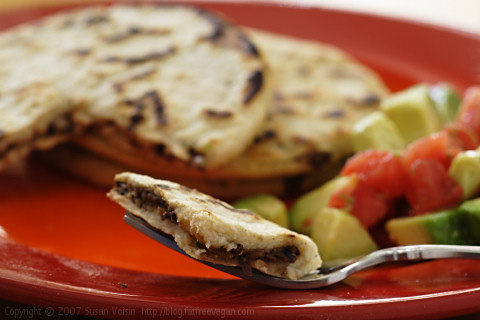
Turns out that the economic footprint of the meals was already pretty frickin' small - about $1.50 for eight of these pupusas which made for two meals for each of us. We added a salad for a pretty healthy, cheap, meatless meal.
The source of the recipe is from Vegetarian Times's April/May, 2011 issue. I would link to the recipe, but their website stinks like tofu-fish...
Pupusas Serves 8
4 cups masa harina, such as Maseca
2 tsp. ground cumin
1 tsp. baking powder
2 tsp. salt
1/2 cup vegetarian refried black beans
1/2 cup crumbled Cotija cheese
8 tsp. vegetable oil
Combine masa harina, cumin, baking powder, and salt in bowl.
Stir in 2 cups warm water, adding more, if needed, to form soft dough.
Cover, and let stand 30 minutes.
Line baking sheet with wax paper. Roll dough into 16 balls. Make indentations in centers; fill 8 balls with 1 Tbs. refried beans. Fill remaining 8 balls with 1 Tbs. cheese. Fold edges over fillings and roll into balls once more. Press into 4-inch disks. Place on prepared baking sheet.
Heat 2 tsp. oil in skillet over medium-high heat. Add 4 pupusas at a time to skillet; cook 5-6 minutes, turning once.
The Girl does cotton to refried beans, so she just mashed up some black beans that she'd made earlier in the day. She also didn't do some with cheese and some with beans. They just got mixed into one filling and used in every pupusa.
The beans, themselves, are also dirt cheap and phenomenally tasty.
Black beans makes a crapload
~8 cups water
2 lbs black beans
onion, finely diced
2 jalapenos
dried chili peppers
2 tsp. salt
Add all ingredients but salt to pot. Bring to boil; simmer for 1 hour. Do not stir.
Add in salt; stir gently. Simmer 1 hour.
The beans make for a great side dish (especially with a little sour cream and salsa stirred in) or as an ingredient in burritos or enchiladas or whatever.
I have the James Balog photography book Tree: A New Vision of the American Forest checked out from the library right now, and it's absolutely stunning. Sadly, the library has the smaller-format second printing of the book. I'd love to have seen these photos in their larger format versions.
Balog's book chronicles his year or photographing some of America's champion trees. Some of the photos are more staged images of smaller trees with simple, white, fabric backdrops, but the most impressive images are huge, stitched photograph collages of the most mammoth of our great trees - redwoods, sequoias - massive specimens that have already are thousands of years old and hundreds of feet high.
Balog found it impossible to get single images of these legends, so he used the rigging of great tree climbers and instead took hundreds of large-format images and used photo editing software to edit them together into some of the most impressive single images that I've ever seen. They're technologically brilliant and absolutely beautiful.
Now I just need to figure out how to get a poster-sized version of that Stagg image.
That's the timeline of nuclear explosions around the world. Thankfully all but two of them were tests, and the rate of the flashes has declined drastically peaking during the Cold War.
But I have to agree with the article's title and ask "What the hell were we thinking?"
Wired isn't a perfect magazine. It's too flashy for its own good - sometimes by a huge margin. But every now and then, they nail one of their larger, feature articles.
This past month saw Wired absolutely kill one of their articles: "Welcome to Armageddon, USA: a tour of America's most toxic town". In this article, they visit the last few residents of Picher, Oklahoma, a former lead and zinc mining town.
In eighty years of active mining, Picher saw 1.7 million tons of lead and 8.8 million tons of zinc taken by mining 181 million tons of ore from the ground, bringing $202 million in total sales to the area. Once the mines were abandoned, however, sinkholes opened under the streets, acid leaked into the water supply, 7000 acres of heavy metal-laden chat piles surrounded the city and blew into town whenever the wind blew, and the city folded up like a cheap suit.
The schools shut down. The police force dried up. The town disappeared.
Except for a few diehards who just won't leave.
The EPA has spent $140 million to replace the topsoil on a couple of thousand plots of land that the government has bought up, but still the place is all but unlivable. The people left have gone full frontier, relying on whatever they can kill or grow.
It's this next statement that freaked me out most from the article...
[Marsha] keeps a small garden with tomatoes and zucchini and okra, and he picks wild asparagus from around the edges of the chat piles, hunts quail and duck, and fishes for bass in nearby rivers. Both say they figure that cooking or freezing will eliminate any toxins.
No, it won't, folks. Heavy metals don't freeze out, and they don't cook out. They're elements. Elements have to react with something to leave. They don't magically change into not-heavy-metals by heating or cooling them.
These people are gonna die.
And, of course, the government has given almost all the poisoned land back to the Native Americans.
No, it's not too soon to laugh about the Deepwater Horizon oil spill - still ongoing and already maybe the third largest oil spill ever - especially when it's Jon Stewart or BPGlobalPR or even the oil industry's forty-year old PR films throwing down the funny.
But it's also not too soon to continue to be angry and to look at the environmental disaster that continues to worsen every minute of every day - forty-two and counting of those since the initial leak and fire onboard the Deepwater Horizon.
We have no clue whatsoever how much oil is pouring into the Gulf of Mexico, and the fear of a well leaking for months and months and months continues to look more like a real possibility as the attempts to staunch the flow of oil each fall by the wayside. Thankfully, the folks in charge - and that phrase should be used with much caution here - have chosen not to go with the nuclear option to seal up the well once and for all.
The thing that amazes me so entirely about this is that every step along the way is a step into uncharted waters here. We have no idea how to seal up an oil leak a mile under the ocean. We have no idea how the dispersed/emulsified oil is going to affect the ocean. We have no clue what a hurricane is going to churn the waters. We - and by we here I mean the smartest petroleum and geologic engineers on the planet - don't have a frickin' clue what the hell is happening or how to stop it.
We're pretty well and totally screwed.
cartoon from the awesome webcomic that I can't recommend on my school-linked blog
And all I can think is that this is yet another example of where every single thing that we do is bad for the environment. Every step we take, every move we make sells our future.
From what I can tell, the denizens of the Big Apple had some old train tracks that they weren't using any more, and they'd kinda stopped mowing the grass up there. After a little while - like ten or twenty years - people noticed that some drought-resistant grasses and trees were growing among the old iron rails and thought "Hey, let's make a park."
A park in the sky...with rainbows water fountains and gum drop benches and cotton candy walkways...
Ok, not quite.
But some people did get together and start fund raising to turn the old railways - known as the High Line - into New York City's newest park, known simply as The High Line. The first part of the park opened this past June, and the rest is going to open in stages as the redesign is completed.
The place looks awesome...check out their blog for some outstanding pics from the first six or so months of the High Line. (I do warn you that a few of the pics are a little on the (insert chili pepper here) side of things).
This thing looks great, and I love the reclamation project.
Mount Rumpke, in case you weren't aware, is our local landfill, a giant monstrosity of a pile of trash begun by a local family that started out taking in trash to feed to their pigs and eventually worked their way into being one of the largest sanitation corporations around, taking in trash and recyclables, renting out port-a-lets, funding a softball team, and even inspiring a local bluegrass band.
That's not the story here, though.
The story here is a little change in their recycling collection business locally. They're been doing curbside recycling for a number of years, charging us eight or so bucks a month to haul away PETE (#1) and HDPE (#2) plastics, glass bottles, paper, and cardboard - as long as it was broken down. In that time, I've gotten increasingly frustrated with friends in other markets who are able to throw all of their plastics into their bins while I have an increasing pile of polypropylene (#5) plastic - yogurt tubs, deli tubs, whatever.
But, this past week we got a revelation.
On Thursday I heard a news story on NPR that Rumpke and the City of Cincinnati were announcing a big increase in the products that Rumpke's curbside recycling would be accepting, adding in all plastic bottles (but not butter tubs) and pizza boxes as they had improved their recycling processing plant. More materials into the recycling bin mean less into my trash can and less into the every-growing Mount Rumpke.
I saw the same story on two different six o'clock local news programs, but I didn't get all the details in either quick little news blurb, so the next morning I headed onto the web to get the full story.
Nothing on channel 5's website...nothing on the Enquirer's website...nothing on channels 19 or 12...heck, the only two blurbs I could find were one on channel 9's website saying that there would be an announcement coming Thursday afternoon and a four-sentence story on the NPR website without any more details than I heard knew before. That last site directed me to the City of Cincinnati's website to find the full list of recyclables - which hadn't been updated since 2007.
From there, onward to the Rumple Recycling website because they must have the new list posted. I mean, the news had just given Rumpke as much positive press in that one day as they'll likely get in the full year.
At least when I called them, they'd know all the details, right? Nope. They just directed me to their website where I actually pointed out to them that the updated list wasn't there.
They wouldn't dare not have all their ducks in a row, right?
Nope, they dropped the ball in every way possible.
They didn't make sure they had updated their website.
They didn't make sure the news websites had any information about the coverage.
They didn't make sure the City of Cincinnati had the info front and center.
They didn't make sure their employees had the new list.
C'mon folks, if you know your company is making an announcement, you have the website already updated - or at least ready to be updated at the touch of a button the moment the announcement is made.
You make sure every front line employee knows the details and is ready to field all calls about the announcement.
You certainly don't drop every possible ball when you get finally some good publicity.
PS - The only thing I can get out of the Rumpke folks is that they're now taking all plastic bottles but not butter tubs. The phone folks couldn't tell me what numbers or specific plastics they were going to be taking, just that they wouldn't take butter tubs.
They are also taking in pizza boxes, too.
Of course, none of this helps me get rid of those deli containers and yogurt tubs. They're neither plastic bottles nor butter tubs. It also doesn't help me get rid of the clamshell packages that I keep finding stupidly used.